Archive for the ‘Arbitration Practice and Procedure’ Category

Eighth Circuit: Arbitrator did not Disregard Parties’ Missouri Choice-of-Law Provision

August 19th, 2018 Arbitration Practice and Procedure, Authority of Arbitrators, Awards, Choice-of-Law Provisions, Exceeding Powers, Judicial Review of Arbitration Awards, Manifest Disregard of the Agreement, Manifest Disregard of the Law, United States Court of Appeals for the Eighth Circuit Comments Off on Eighth Circuit: Arbitrator did not Disregard Parties’ Missouri Choice-of-Law Provision

Introduction

Choice-of-Law Provision 1

Choice-of-Law Provision 1

A choice-of-law provision is as much a part of a parties’ contract as any other, and an arbitrator might manifiestly disregard the parties’ contractual choice-of-law, which might provide grounds for vacating the award under Section 10(a)(4) of the Federal Arbitration Act (“FAA”). But, as well-illustrated by the U.S. Court of Appeals for the Eigth Circuit’s decision in Beumer Corp. v. ProEnergy Servs., LLC, ___ F.3d ____, slip op. (8th Cir. August 8, 2018), the circumstances that might justify such a decision would be very unusual, to say the least.

Beumer Corp. v. ProEnergy Servs., LLC

Choice-of-Law Provision 2

Choice-of-Law Provision 2

Owner and Contractor had a construction contract that contained an arbitration agreement, limitation-of-liability, provision, and a Missouri choice-of-law clause. The Owner complained that the Contractor’s work was deficient and, accordingly, no payment was due. The Contractor commenced arbitration for the amount due under the contract and the Owner counterclaimed for damages.

The parties disputed the scope and enforceability of their contract’s limitation of liability provision, which stated:

Notwithstanding any of the foregoing or any other term in this Contract, the total liability of Contractor for any loss, indemnity, damage or delay of any kind will not under any circumstances exceed 100% of the Contract Sum.

The contract contained a broad Missouri choice-of-law clause, and provided that a prevailing party could collect its attorney’s fees.

The Award

Choice-of-Law Provision 3

Choice-of-Law Provision 3

The Arbitrator ruled that the clause was enforceable, that the Contract Sum (i.e., the liability cap) was $699,702.39., and that the terms “loss, indemnity, damage or delay of any kind” did not include the prevailing party’s contractual right to attorney fees. The Arbitrator thus awarded Beumer: (a) $699,702.39 in damages; (b) $191,680.14 in pre-judgment interest; (c) post-judgment interest at 9%; and (d) $916,027.90 in attorney’s fees and expenses.

On its motion to vacate the Award the Contractor did not dispute that the Arbitrator “arguably construed” the limitation of liability clause, but contended that the Arbitrator exceeded its powers by “disregarding” the Missouri choice-of-law clause, because: (a) the Arbitrator relied on caselaw from four jurisdictions outside of Missouri to support his construction of the limitation of liability provision as exclusive of costs and attorney fees, and did not cite any Missouri decisions on this construction question; and (b) the Contractor claimed that the Missouri cases required a cost-inclusive interpretation of the clause, not a cost-plus one.

The Arbitrator did not Disregard the Choice-of-Law Provision

Choice-of-Law Provision 4

Choice-of-Law Provision 4

Did the Arbitrator exceed his powers by ruling that the limitation of liability clause did not limit liability for contractual attorney fees? The Eighth Circuit, in a well-reasoned decision, said the answer was “no.” Continue Reading »

The Fourth Circuit: What Constitutes a Final Award and Who Makes the Call?

August 3rd, 2018 Appellate Practice, Arbitrability, Arbitration Practice and Procedure, Authority of Arbitrators, Awards, Confirmation of Awards, Exceeding Powers, Federal Arbitration Act Enforcement Litigation Procedure, Grounds for Vacatur, Judicial Review of Arbitration Awards, Manifest Disregard of the Agreement, Manifest Disregard of the Law, United States Court of Appeals for the Fourth Circuit 1 Comment »
Final Award 2 - yay-15399450

Final Award 2

What constitutes a “final arbitration award” for purposes of the Federal Arbitration Act is important because it bears on whether an award can be confirmed, vacated, or modified under Sections 9, 10, or 11 of the Federal Arbitration Act (the “FAA”). We addressed the basics concerning final awards in a 2009 post, here.

In Northfolk Southern Railway Co. v. Sprint Communications Co., L.P., 883 F.3d 417 (4th Cir. 2018), the U.S. Court of Appeals for the Fourth Circuit was faced with the question whether an award (the “Appraisal Award”), convened under an agreement’s appraisal clause, and issued by three appraisers, was a final arbitration award under the FAA. The unusual procedural posture of the case raised an additional, related question: whether under the FAA an arbitration panel, convened under the arbitration provision of the parties’ agreement, had the authority to declare the Appraisal Award to be a final award. That question matters, for if an arbitration panel has that power, then its decision concerning finality is subject only to the very highly deferential review permitted by Section 10 of the FAA. See First Options of Chicago, Inc. v. Kaplan, 514 U.S. 938, 942-43 (1995); Oxford Health Plans LLC v. Sutter, 133 S. Ct.  2064, 2068-69 (2013).

Concededly with the benefit of 20/20 hindsight, we wonder whether a different litigation and appellate strategy might have yielded a different outcome. The Court held that the Appraisal Award was not final, and remanded the matter back to the appraisers. But the Court did not, for the reasons set forth below, definitively answer the “who” question. The Court’s decision that the Appraisal Award was not final was unquestionably correct if one considers from a purely objective standpoint, without deference to the Arbitration Award, which declared that the Award was final.  But the correct outcome would be considerably less certain had the Railroad sought confirmation of the Arbitration Award and urged the Court to accord deference to the arbitrators who made it.

Background: Northfolk Southern Railway Co. v. Sprint Communications Co., L.P., 883 F.3d 417 (4th Cir. 2018)

Final Award 1 - yay-1618918-digital

Final Award 1

The dispute between Northfolk Southern Railway Co. (the “Railroad” or the “Appraisal Award Defending Party”) and Sprint Communications Co., L.P. (the “Carrier” or the “Appraisal Award Challenging Party”) arose out of a 25-year-term 1987 licensing agreement (the “Agreement”) under which the Carrier’s predecessor licensed from the Railroad’s predecessor the right to use for fiber-optics-cable purposes certain parts of the Railroad’s rights of way. The Carrier renewed that Agreement for an additional 25-year term (the “renewed Agreement term”), and a dispute arose about the renewal price. Continue Reading »

Second Circuit Sets Evident Partiality Standard for Party-Appointed Arbitrators on Industry Tripartite Arbitration Panels

July 26th, 2018 Appellate Practice, Arbitration Agreements, Arbitration as a Matter of Consent, Arbitration Practice and Procedure, Awards, Evident Partiality, Federal Arbitration Act Enforcement Litigation Procedure, United States Court of Appeals for the Second Circuit, United States District Court for the Southern District of New York Comments Off on Second Circuit Sets Evident Partiality Standard for Party-Appointed Arbitrators on Industry Tripartite Arbitration Panels

Section 10(a)(2) of the Federal Arbitration Act (the “FAA”) authorizes courts to vacate awards “where there was evident partiality.  .  .  in the arbitrators.  .  .  .” 9 U.S.C. § 10(a)(2). As respects neutral arbitrators, the U.S. Court of Appeals for the Second Circuit has long held that “[e]vident partiality may be found only where a reasonable person would have to conclude that an arbitrator was partial to one party to the arbitration.”  Scandinavian Reinsurance Co. Ltd. v. Saint Paul Fire and Marine Ins. Co., 668 F.3d 60, 64 (2d Cir. 2012) (quotations and citations omitted).

But, particularly in industry and labor arbitration, the parties do not necessarily intend that party-appointed arbitrators on tripartite panels are neutral, that is, disinterested in the outcome, impartial and independent. Can a party vacate an award based on the “evident partiality” of a non-neutral, party-appointed arbitrator, and if so, what standard applies to such a challenge? Continue Reading »

Appellate Division, First Department Vacates Arbitration Award Because it Rewrote the Parties’ Collective Bargaining Agreement

July 13th, 2018 Appellate Practice, Arbitration Agreements, Arbitration as a Matter of Consent, Arbitration Practice and Procedure, Authority of Arbitrators, Awards, Labor Arbitration, Manifest Disregard of the Agreement, New York Arbitration Law (CPLR Article 75), New York State Courts Comments Off on Appellate Division, First Department Vacates Arbitration Award Because it Rewrote the Parties’ Collective Bargaining Agreement

yay-1663484-digitalNew York’s arbitration law (Article 75 of the CPLR), like the Federal Arbitration Act (the “FAA”), strictly limits award challenges premised on an arbitrator’s disregard of the parties’ contract. Arbitrator interpretations of the parties’ agreement cannot be second-guessed, even if the arbitrator has “disregarded” “the apparent, or even the plain, meaning of the words of the contract….” Maross Constr. v Central N. Y. Regional Transp. Auth., 66 N.Y 2d 341, 346 (1985) (quotations and citations omitted). To succeed, an award challenger must show that the  award “is irrational or clearly exceeds a specifically enumerated limitation on the arbitrator’s power.” Kowaleski  v. New York State Dep’t Correctional Serv., 16 N.Y. 3d 85, 91 (2010).

In City of New York v. District Council 37, ___ A.D. 3d ___, 2018 NY Slip Op 3220 (1st Dep’t May 3, 2018), the New York’s Supreme Court, Appellate Division, First Department set aside an award because it exceeded “a specifically enumerated limitation” on arbitral power: The parties’ agreement prohibited the arbitrator from adding to or modifying the agreement.

“The arbitrator’s decision,” said the Court, “rewrote the contract for the parties by expanding the number of workers entitled to the [collective bargaining agreement’s] assignment differential, when the contract expressly limited the differential to workers at a specific facility.” 2018 N.Y. Slip Op. 3220 at *1.

Acknowledging that “[a] provision in a contract that the arbitrator may not alter or modify a contract does not limit the arbitrator’s power to resolve the dispute by interpreting the contract based on his or her findings as to the parties’ intent[,]” the Court explained that “an award should be vacated where it is not derived from the contract, but from the deliberate and intentional consideration of matters outside the contract.” 2018 N.Y. Slip Op. 3220 at *1.

To learn more about vacating awards based on an arbitrator’s manifest disregard of the contract click here, here, here, here, here, and here.

Photo Acknowledgement:

The photo featured in this post was licensed from Yay Images and is subject to copyright protection under applicable law.

Class Arbitration: Second Circuit in Jock II Rejects Jock I Bootstrapping Bid and Nixes Class Certification Award that Purported to Bind Non-Parties

July 26th, 2017 Arbitrability, Arbitration Agreements, Arbitration as a Matter of Consent, Arbitration Practice and Procedure, Authority of Arbitrators, Awards, Class Action Arbitration, Consent to Class Arbitration, Exceeding Powers, Judicial Review of Arbitration Awards, United States Court of Appeals for the Second Circuit Comments Off on Class Arbitration: Second Circuit in Jock II Rejects Jock I Bootstrapping Bid and Nixes Class Certification Award that Purported to Bind Non-Parties

Arbitration law’s “first principle” is “arbitration is a matter of consent, not coercion[,]” and class arbitration is no exception. (See, e.g., here.) In Jock v. Sterling Jewelers, Inc., 703 Fed.Appx. 15 (2d Cir. 2017) (summary order), the U.S. Court of Appeals for the Second Circuit enforced that principle by vacating and remanding the district court’s judgment, which confirmed in part a class arbitration class certification award that purported to bind non-parties, that is, persons (other than named class representatives), who had not opted into the putative class.

Because the Second Circuit held in an earlier appeal, Jock v. Sterling Jewelers, Inc., 646 F.3d 113, 124 (2d Cir. 2011) (“Jock I”), that the “issue of whether the agreement permitted class arbitration was squarely presented to the Arbitrator,” see id., the district court concluded that holding was law of the case, and confirmed in part an award certifying a class that “included absent class members, i.e., employees other than the named plaintiffs and those who have opted into the class.” 703 Fed. Appx. at 17-18.

Photographer: stuartmilesThe Second Circuit vacated and remanded the judgment partially confirming the certification award because it purported to bind absent class members, who (because of their absence)  could not have “squarely presented’ to the arbitrator the question whether the agreement authorized class procedures, let alone the issue of whether they should be deemed part of a class in a class arbitration to which they had not consented. See 703 Fed. Appx. at 16, 17-18.

While in Jock I the parties had “squarely presented to the arbitrator” the issue of whether the agreement “permitted class arbitration,” Jock I did not address the more “narrow question” “whether an arbitrator, who may decide … whether an arbitration agreement provides for class procedures because the parties `squarely presented’ it for decision, may thereafter purport to bind non-parties to class procedures on this basis.” Id. at 18. The answer to that question is “no”— as Associate Justice Samuel A. Alito, Jr. suggested in his concurring opinion in Oxford Health Plans LLC v. Sutter, 133 S. Ct. 2064, 2071-72 (2013) (Alito, J., concurring), and as the Second Circuit confirmed in Jock II. See 703 Fed. Appx. at 16, 17-18.

Photo Acknowledgements:

All photos used in the text portion of this post are licensed from Yay Images and are subject to copyright protection under applicable law. The Yay Images abbreviations of the photographer’s name for each of the two images are:

Image 1: CartoonResource

Image 2: stuartmiles


Does the Presumption of Arbitrability Apply if a Contract Contains two Broad, Overlapping Forum Selection Clauses, one for Arbitration and one for Litigation?

June 7th, 2015 Arbitrability, Arbitration Agreements, Arbitration Practice and Procedure, Contract Interpretation, Contract Interpretation Rules, FAA Preemption of State Law, Federal Policy in Favor of Arbitration, Moses Cone Principle, Presumption of Arbitrability, Stay of Litigation, United States Court of Appeals for the Ninth Circuit Comments Off on Does the Presumption of Arbitrability Apply if a Contract Contains two Broad, Overlapping Forum Selection Clauses, one for Arbitration and one for Litigation?

Introduction

yay-4719842---Copy


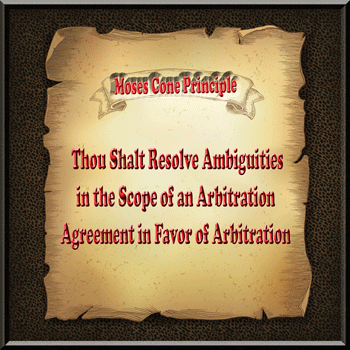
Back in 1983 the U.S. Supreme Court, in the landmark decision Moses H. Cone Memorial Hosp. v. Mercury Constr. Corp., 460 U.S. 1, 24-25 (1983) (Brennan, J.), famously declared that “[t]he [Federal] Arbitration Act establishes that, as a matter of federal law, any doubts concerning the scope of arbitrable issues should be resolved in favor of arbitration, whether the problem at hand is the construction of the contract language itself or an allegation of waiver, delay, or a like defense to arbitrability.” Moses Cone thus established that there was a presumption in favor of arbitrability in cases governed by the Federal Arbitration Act, a conclusion that a number of other lower courts had previously reached, and which the Court had adopted about 23 years previously as a matter of federal labor law derived from Section 301 of the Labor Management Relations Act (sometimes referred to as the “Taft-Hartley Act”). See United Steel Workers of Am. v. Warrier & Gulf Nav. Co., 363 U.S. 574, 582-83 (1960) (Douglas, J.) (“An order to arbitrate the particular grievance should not be denied unless it may be said with positive assurance that the arbitration clause is not susceptible of an interpretation that covers the asserted dispute. Doubts should be resolved in favor of coverage.”)

The presumption of arbitrability is not a talismanic solution to every arbitration-law related problem. In fact it is designed to address only questions about the scope of an arbitration agreement.

The presumption has two related components. First, when courts construe the scope provision of an arbitration agreement to determine what merits-related issues the parties agreed to arbitrate, the court resolves ambiguities in favor of arbitration.  See, e.g., Mastrobuono v. Shearson Lehman Hutton, Inc., 514 U.S. 52, 62 (1995). Second, it presumes that procedural issues arising out of arbitrable disputes, and contract-related defenses to arbitrability—that is, “allegation[s] of waiver, delay and like defenses to arbitrability[,]” are presumptively for the arbitrator. See Moses Cone, 460 U.S. at 24-25; Howsam v. Dean Witter Reynolds, Inc., 537 U.S. 79, 84 (2002).

Roughly ten days ago, in a post about U.S. Circuit Judge Richard A. Posner’s Sprint Spectrum decision, we wrote about how some judges have interpreted the presumption too expansively:

The federal policy in favor of arbitration has, at least arguably, been interpreted to apply more expansively than the U.S. Supreme Court likely intended. As a result, even though the U.S. Supreme Court has said many times that arbitration is supposed to be a “matter of contract,” or one of “consent not coercion,” an overly expansive interpretation of the policy has, at least in some cases, arguably resulted in arbitration agreements being placed on a considerably more advantaged footing than ordinary contracts. As we read it, Judge Posner’s comment in Roughneck raises the question whether this might have more to do with “limit[ing] judicial workloads” than a desire to enforce contracts as written and according to their terms.

(Read our Sprint Spectrum post here.)

With all the hoopla about the presumption of arbitrability, one would think it very difficult to find a case that didn’t apply the presumption of arbitrability in a situation where it was supposed to apply it. In general that’s probably true, but on June 2, 2015 the U.S. District Court for the Western District of Washington proved that truth is not a universal one.

In Scolari v. Elliot Rust Co., No. C15-5163 (BHS), slip op. (W.D. Wash. June 2, 2015) the court considered whether ambiguity created by apparently conflicting forum selections clauses: one arbitral and two judicial. While the Court’s reasoning indicated that it considered the issue before it one of contract interpretation—the resolution of ambiguity—it nevertheless held that the ambiguity had to be resolved against the drafter of the contract, which the district court thought Washington law required, rather than in favor of arbitration, which was what federal law required. While it apparently recognized that application of the presumption, rather than a state-law contra proferentem rule, would have required the court to stay the litigation, it nevertheless denied the requested stay of litigation, concluding that the issue before it concerned the enforceability of the arbitration agreement, rather than an interpretation of its scope.

The net effect of the ruling was for the district court to implicitly have found that a judicial forum selection clause trumped an arbitral one, simply because they overlapped in scope, and that accordingly the arbitral forum selection clause was not enforceable. There was no legal basis for such a finding and the district court cited none.

The seriousness of the error was compounded by the district court’s acknowledgement that the arbitration proponent had advanced a reasonable interpretation of the arbitration agreement and judicial forum selection clauses, which harmonized them, and would have allowed arbitration to proceed, with the district court staying its hand in the interim. Instead of adopting that interpretation, it said that the arbitration challenger’s interpretation was likewise “reasonable,” but the court did not say what the challenger’s interpretation was, and given the disposition of the case, we assume that the “interpretation” was that the parties must not have intended to include a concededly existing and valid arbitration agreement in their agreement. But that interpretation not only ignored the presumption of arbitrability, but the general rule of contract interpretation that one contract provision not be construed to negate another.

We do not know whether the arbitration proponent preserved the argument for appeal, but there was another ground for a stay of litigation in this case that would have bypassed the issue of the presumption of arbitrability. The arbitration agreement contained a delegation clause, which clearly and unmistakably required the parties to submit to arbitration all disputes about arbitrability. Because there was no dispute about the existence or validity of the delegation clause, the Court should have held that the resolution of the apparent conflict between arbitral and judicial forum selection clauses was a question for the arbitrators.

If the arbitration proponent decides to appeal the decision, we hope that the U.S. Court of Appeals for the Ninth Circuit will correct these errors without delay, so that the parties can arbitrate their disputes, which is, after all, what they agreed to do.

Background

yay-12775922-digitalScolari v. Elliot Rust Co., No. C15-5163 (BHS), slip op. (W.D. Wash. June 2, 2015), arose out of the purchase, sale, termination and buyback of an interest in a limited liability company. Effective January 1, 2013 the plaintiff (the “Buyer”) purchased a ten-percent ownership interest in  Elliot Rust Companies, LLC (the “LLC”), the purchase and sale of which was governed by a “Grant Agreement” executed by the parties “according to the terms of [an] Amended and Restated LLC Agreement of Elliot Rust Companies, LLC dated January 1, 2013.” Both agreements were apparently part of the same transaction and were entered into at or about the same time.

The Buyer and LLC were the only parties to the Grant Agreement, which provided that the Buyer would acquire its 10% interest “according to the terms of the terms of the Amended and Restated LLC Agreement of Elliot Rust Companies, LLC dated January 1, 2013

The Grant Agreement provided, among other things, that:

[Scolari] understands, acknowledges and agrees that, upon execution of this Grant Agreement and the joinder to the LLC Agreement, [Scolari] shall, without further action or deed, thereupon be bound by the LLC Agreement, as it may thereafter be restated or amended, as though a direct signatory thereto.

It contained a “jurisdiction” clause that stipulated Washington law as governing and the U.S. District Court for the Western District of Washington as the exclusive judicial forum:

Governing Law: Jurisdiction. This Grant Agreement and the transaction contemplated hereby shall be governed by and construed according to the laws of the state of Washington. With respect to any dispute arising out of or related to this Grant Agreement or the LLC Agreement, the parties hereby consent to the exclusive jurisdiction of the United States District Court for the Western District of Washington. . . .

yay-1916763-digitalThe LLC Agreement, unlike the Grant Agreement, contained a broad arbitration agreement, which said:

Arbitration. All disputes, claims or controversies relating to this Agreement that are not resolved by mediation shall be submitted to final and binding arbitration. . . . Questions or arbitrability or the scope of the parties’ agreement to arbitrate shall be determined by the arbitrator.

But like the Grant Agreement, the LLC Agreement also contained a jurisdiction and venue clause:

Jurisdiction and Venue. Any suit involving any dispute or matter arising under this Agreement may only be brought in the United States District Court for the Western District of Washington or the Superior Court of Pierce County. All Members hereby consent to the exercise of personal jurisdiction by any such court with respect to any such proceeding.

The LLC terminated the plaintiff on November 6, 2014, and on December 15, 2014 offered to buy plaintiff’s 10% interest out for $158,882.60. The plaintiff refused the offer one week later, claiming that he did not believe it to be accurately valued.

yay-13760132Unable to agree a resolution the plaintiff filed suit in March 2015, requesting a judgment declaring he has a 20% interest in the profits of the LLC, and equitable relief.

The LLC moved on April 3, 2015 to dismiss for improper venue or to stay the action pending arbitration under Section 3 of the Federal Arbitration Act pending arbitration. The Court denied the motion.

The District Court’s Analysis and Conclusions

The Court began its analysis by acknowledging that its “role” was confined “‘to determining (1) whether a valid agreement to arbitrate exists and, if it does, (2) whether the agreement encompasses the dispute at issue.’” Slip op. at 4 (quoting Chiron Corp. v. Ortho Diagnostic Sys., Inc., 207 F.3d 1126, 1130 (9th Cir. 2000)). If the arbitration proponent establishes that the answers to both questions are “yes,” then, said the Court, the Court must “‘enforce the arbitration in accordance with its terms.’” Slip op. at 4 (quoting 207 F.3d at 1130). And in discussing the standard applicable to question (2), the Court, playing homage to the strong presumption in favor of arbitration, said “‘any doubts concerning the scope of arbitrable issues should be resolved in favor of arbitration. . . .’” Slip op. at 4 (quoting 207 F.3d at 1131).

So far, so good. But having accurately stated the governing rules, the Court inexplicably failed to heed them. Continue Reading »

Can a Party Obtain Post-Judgment Relief from a Confirmed Arbitration Award Procured by Fraud?

May 26th, 2015 Arbitration Practice and Procedure, Arbitration Risks, Asbestos-Related Claims, Bad Faith, Confirmation of Awards, Corruption or Undue Means, Definition of Occurrence, Federal Courts, Federal Rules of Civil Procedure, Final Awards, Grounds for Vacatur, United States Court of Appeals for the Second Circuit, United States District Court for the Southern District of New York Comments Off on Can a Party Obtain Post-Judgment Relief from a Confirmed Arbitration Award Procured by Fraud?

Introduction

Relief from an Arbitration Award Procured by Fraud

yay-14955744-digital

Section 10(a)(1) of the Federal Arbitration Act authorizes Courts to vacate arbitration awards that were “procured by fraud, corruption or undue means.”  9 U.S.C. § 10(a)(1). (For a discussion of Section 10(a)(1), see L. Reins. & Arb. Law Forum post here.) But a motion to vacate an arbitration award procured by fraud (or otherwise) is subject to a strict three-month deadline, and Section 10, unlike certain of its state-law counterparts, does not provide for tolling of the three-month deadline on the ground the challenging party did not know or have reason to know it had grounds to allege the arbitration award was procured by fraud. Compare 9 U.S.C. § 10(a)(1) with 2000 Revised Uniform Arbitration Act § 23(b) (Uniform Law Comm’n 2000) (If “the [movant] alleges that the award was procured by corruption, fraud, or other undue means, [then, in that].  .  .   case the [motion] must be made within 90 days after the ground is known or by the exercise of reasonable care would have been known by the [movant].”);  1955 Uniform Arbitration Act § 12(b) (Uniform Law Comm’n 1955) ( “[I]f predicated upon corruption, fraud or other undue means, [the motion to vacate] shall be made within ninety days after such grounds are known or should have been known.”).

Once an award has been confirmed, it has the same force and effect as any other judgment of the court. See 9 U.S.C. § 13. Federal Rule Civ. P. 60(b) provides that “[o]n motion and just terms, the court may relieve a party or its legal representative from a final judgment, order, or
proceeding for the following reasons:.  .  .  (3) fraud (whether previously called intrinsic or extrinsic), misrepresentation, or misconduct by an opposing party.  .  .  .” Fed. R. Civ. P. 60(c) provides that “[a] motion under Rule 60(b) must be made within a reasonable time—and for reasons (1), (2), and (3) [i.e., fraud, misrepresentation or misconduct] no more than a year after the entry of the judgment or order or the date of the proceeding.” Fed. R. Civ. P. 60(c).

So can a challenging party obtain relief from a confirmation judgment if: (a) an award-challenging party contends the Court entered judgment oin an arbitration award procured by fraud; (b) by extension, the judgment confirming the award was itself procured by fraud; (c) the award-challenging party did not know or have reason to know it was at the wrong end of an arbitration award procured by fraud until after the three-month statute of limitations for vacating an award had elapsed; and (d) the award-challenging party makes a timely motion for post-judgment relief under Fed. R. Civ. P. 60(b)? According to a district court judge of the U.S. District Court for the Southern District of New York, the answer is “no.”


Arrowood Indem. Co. v. Equitas Insurance Ltd., No. 13-cv-7680 (DLC), slip op. (S.D.N.Y. May 14, 2015)

No Post-Judgment Relief from Arbitration Award Procured by Fraud (Alleged or Otherwise)

Background

yay-677177

Arrowood arose out of an excess-of-loss treaty Arrowood’s predecessor(s) in interest had entered into with Underwriters at Lloyd’s in the 1960s. The terms of the treaty were apparently part of, or incorporated into, a “Global Slip,” which the Court, without much elaboration, described as “a complex contractual  reinsurance program.” The Global Slip was first negotiated in 1966 and effective January 1, 1967 through December 31, 1968. It was apparently renewed a number of times thereafter, though the court does not say for what period or periods. The renewal agreements were “substantially similar” although they “contain[ed] new contractual language.” Slip op. at 2.

The Global Slip covered (apparently among other things) losses in excess of $1 million incurred under Arrowood’s casualty insurance policies under three different types of coverage. At issue was “Common Cause Coverage,” which covered losses arising out of an “occurrences” during the contract term, provided the occurrence or occurrences were the “probable common cause or causes” of more than one claim under the policies. The Global Slip also contained a “First Advised” clause, which said that “this Contract does not cover any claim or claims arising from a common cause, which are not first advised during the period of this Contract.”

yay-1299629-digitalLike so many other liability insurers, Arrowood began receiving, adjusting and settling asbestos bodily injury claims beginning in the 1980s. Underwriters at Lloyd’s London insisted that Arrowood present its asbestos reinsurance claims on a per claimant per exposure-year basis, absorbing one $1 million retention each year against the total asbestos claim liabilities allocated to that year under the Underwriters’ per claimant per exposure-year allocation methodology.

In 2008 Arrowood, after reviewing the contract language, stopped using exclusively the Underwriters-prescribed asbestos personal-injury claim reinsurance allocation methodology, which it had followed for almost 25 years, and began presenting a number of claims under the Common Cause Coverage provision of the Global Slip . Because those claims were not, “first advised” in the years 1967 or 1968, the Underwriters denied them.

The Arbitration and Confirmation Proceedings

One of the parties demanded arbitration in October 2010, and a tripartite panel was appointed. The Underwriters argued, among other things, that: (a) the parties’s 25-year course of dealing evidenced a binding agreement on how asbestos claims would be presented to the Underwriters; (b) some claims fell exclusively under employer’s liability coverage; and (c) Common Cause Coverage  did not apply because the requirements of the First Advised Clause were not satisfied. Continue Reading »

Circuit Court Judge Richard A. Posner Weighs in on Federal Policy in Favor of Arbitration

May 23rd, 2015 Appellate Practice, Arbitrability, Arbitration Agreements, Arbitration as a Matter of Consent, Arbitration Practice and Procedure, Class Action Waivers, Contract Interpretation, Federal Arbitration Act Enforcement Litigation Procedure, Federal Policy in Favor of Arbitration, Labor Arbitration, Practice and Procedure, Presumption of Arbitrability, United States Court of Appeals for the Seventh Circuit, United States Supreme Court Comments Off on Circuit Court Judge Richard A. Posner Weighs in on Federal Policy in Favor of Arbitration

Introduction

Ronald v. Sprint Spectrum L.P., No. 14-3478, slip op. (7th Cir. May 11, 2015) (Posner, J.)

Ronald v. Sprint Spectrum L.P., No. 14-3478, slip op. (7th Cir. May 11, 2015) arose out of a class action lawsuit brought in the U.S. District Court for the Northern District of Illinois by a putative class of mobile phone customers—represented by Mr. and Ms. Andermann (the “Andermanns”)—against Sprint, which sought damages for alleged violations of the Telephone Consumer Protection Act, 47 U.S.C. § 227.

Sprint moved to compel arbitration, but the district court denied its motion. Sprint appealed to the U.S. Court of Appeals for the Seventh Circuit as authorized by 9 U.S.C. § 16(a)(1)(B). The Seventh Circuit, in an opinion written by Circuit Judge Richard A. Posner, and joined in by Circuit Judge Diane S. Sykes and Chief District Court Judge Philip P. Simon of the Northern District of Indiana (sitting by designation), reversed and remanded with instructions to compel arbitration.

The Sprint Spectrum facts; the legal rules and principles that determined the outcome; and the outcome itself were not controversial.  Had the court limited its task to applying the material facts to the applicable law, then the case likely would not have warranted a reported opinion.

But occasionally appellate judges, particularly ones as prominent, skilled and engaged as Judge Posner, will use a case like Sprint to make a point in passing that might influence other judges in the future and perhaps provide valuable information to attorneys and their clients. Judge Posner, with the apparent blessing of the other two judges, used the case to make a couple of points, one purely legal, the other bearing on both the law and, and at least to some extent, on matters pertinent to court administration.

The purely legal issue concerned the  proper scope and practical significance of the federal policy in favor of arbitration, which a majority of the U.S. Supreme Court, Judge Posner and some other judges apparently believe lawyers and judges may misunderstand or misinterpret. In Sprint Spectrum Judge Posner, in dictum, raises the topic and shares some important insights about it.

The hybrid legal and judicial administration point concerned his view of the merits of the underlying Telephone Consumer Protection Act dispute.  While the Court acknowledged that it was for the arbitrators to decide the merits, it nevertheless explained why it believed the claim would likely fail, whether in arbitration or in court.

Sprint Spectrum: Background

yay-985888-digital---CopyIn 2000 the Andermanns entered into a two-year renewable mobile-phone service contract with U.S. Cellular, which was renewed continuously, and for the last time in 2012. The contract contained an arbitration agreement requiring arbitration of “any controversy or claim arising out of or relating to this agreement.” The parties agreed that the obligation to arbitrate would “survive[] the termination of [the] [mobile phone] service agreement[,]” and that “U.S. Cellular may assign this Agreement without notice to” the customer.

In 2013 U.S. Cellular sold the contract to Sprint, and notified the Andermanns of the sale in a letter sent months later. The letter informed the Andermanns that their service would be terminated effective January 2014  because of a compatibility problem between the Andermann’s mobile phone and the Sprint network. The letter explained that the Andermanns would have to obtain a new cell phone or find a new carrier, but “that Sprint was offering attractive substitutes for the terminated service,” and, if interested, the customer should contact Sprint by telephone. See slip op. at 2.

In December Sprint phoned the Andermanns to remind them that their service was about to expire, and added that Sprint had “a great set of offers and devices available to fit [their] needs.'” Slip op. at 3. Sprint called each of three members of the Andermann family twice (a total of six calls), but by the time the calls were made, the Andermanns had obtained cell phone service from another carrier.

yay-10331162-digitalThe Andermanns did not answer any of the six calls, except by commencing a class action lawsuit against Sprint, which contended that the unsolicited calls violated the Telephone Consumer Protection Act. Sprint moved to compel arbitration, contending that the dispute arose out of and related to the contract renewed in 2012. Even though that contract was between U.S. Cellular and the Andermanns, U.S. Cellular had, as permitted by the contract, assigned its rights to Sprint, who had now stepped into U.S. Cellular’s shoes under the contract.

The Seventh Circuit’s Decision

The district court denied Sprint’s motion because its contract with the Andermanns had terminated prior to the allegedly offending telephone calls at issue in the lawsuit. The district court reasoned that the dispute did  not arise out of or relate to the terminated agreement.

But the Court  said “[a]ctually, there’s an intimate relation” between the dispute and the contract. “The contract,” said the Court, authorized an assignment, and because of the incompatibility of the assignor’s (U.S. Cellular’s) cellphones and the assignee’s (Sprint’s) mobile phone network, Sprint had had to terminate the U.S. Cellular customers, such as the Andermanns, whom it had acquired by virtue of the assignment.  .  .  .” Slip op. 4. Sprint made the calls, and “offer[red] substitute service[]”  “to prevent the loss of.  .  .  customers because of the incompatibility.  .  .  .” Slip op. at 4.

yay-10348120-digitalThe Andermanns attempted to support their argument by offering an “untenable interpretation” of Smith v. Steinkamp, 318 F.3d 775, 777 (7th Cir. 2003). See Slip op. at 4. Steinkamp explained “‘absurd results’ would ensue if the arising from and relating to provisions contained in a payday loan agreement defining what disputes would have to arbitrated rather than litigated, were cut free from the loan and applied to a subsequent payday loan agreement that did not contain those provisions.” Slip op. at 4-5 (quoting Steinkamp, 318 F.3d at 777).

The Andermanns argued that Steinkamp suggested that the same type of “absurd results” would ensue under the facts of this case. But Steinkamp, explained the Court, “is not this case[,]” which concerns a single contract containing an arbitration agreement, not two successive contracts, one with an arbitration agreement and one without an arbitration agreement. See slip op. at 5.

yay-2220659-digitalWhile the Andermanns received a mild (and perhaps well-deserved) rebuke, Sprint’s argument prompted the verbal version of a roll of the eyes coupled with a quiet sigh—not so much because there was anything really wrong with the argument, but presumably because it overstated the importance of the federal policy in favor of arbitration. But that gave Judge Posner an opportunity to make a somewhat subtle, but important point.

The Court  said “Sprint gilds the lily, however, in telling us that arbitration is a darling of federal policy, that there is a presumption in favor of it, that ambiguities in an arbitration clause should be resolved in favor of arbitration, and on and on in this vein.” Slip op. at 5. “It’s true,” said the Court, “that such language (minus the “darling”) appears in numerous cases.” Slip op. at 5 (citations omitted): “But the purpose of that language is to make clear, as had seemed necessary because of judges’ historical hostility to arbitration, that arbitration was no longer to be disfavored — especially in labor cases, see, e.g., Granite Rock Co. v. International Brotherhood of Teamsters, 561 U.S. 287, 298­-99 (2010), where arbitration is now thought a superior method of dispute resolution to litigation.” Slip op. at 5.

Noting that “[t]he Federal Arbitration Act is inapplicable to labor disputes,  .  .  . and merely makes clauses providing for the arbitration of disputes arising out of transactions involving interstate or foreign commerce.  .  . enforceable in federal and state courts[,]” the Court said it was “not clear that arbitration, which can be expensive because of the high fees charged by some arbitrators and which fails to create precedents to guide the resolution of future disputes, should [in commercial cases] be preferred to litigation.” Slip op. at 5-6. Continue Reading »

SCOTUS Denies Americo and Jupiter Medical Cert. Petitions: All Eyes now on DIRECTV. . . .

May 19th, 2015 American Arbitration Association, Appellate Practice, Arbitrability, Arbitration Agreements, Arbitration as a Matter of Consent, Arbitration Practice and Procedure, Arbitration Provider Rules, Arbitrator Selection and Qualification Provisions, Awards, Choice-of-Law Provisions, Class Action Arbitration, Class Action Waivers, Confirmation of Awards, Consent to Class Arbitration, Contract Interpretation, FAA Preemption of State Law, Federal Arbitration Act Enforcement Litigation Procedure, Judicial Review of Arbitration Awards, State Courts, United States Supreme Court Comments Off on SCOTUS Denies Americo and Jupiter Medical Cert. Petitions: All Eyes now on DIRECTV. . . .

yay-34842-digital

On March 28, 2015 we reported (here) that the U.S. Supreme Court (“SCOTUS”) had asked for a response to the petition for certiorari in Americo Life, Inc. v. Myer, 440 S.W.3d 18 (Tex. 2014). In Americo the Texas Supreme Court held that an arbitration award had to be vacated because it was made by a panel not constituted according to the parties’ agreement. The parties’ agreement, among other things, incorporated the American Arbitration Association (the “AAA”)’s rules, which at the time the parties entered into the contract followed the traditional, industry arbitration rule that party-appointed arbitrators may be partial, under the control of the appointing party or both. But by the time the dispute arose the AAA Rules had been amended to provide that the parties are presumed to intend to require parties to appoint only neutral arbitrators—that is, arbitrators that are both impartial and independent.

Five Justices of the nine-member Texas Court determined that the parties had agreed that party-appointed arbitrators need not be impartial, only independent. Because the AAA had, contrary to the parties’ agreement, disqualified the challenging party’s first-choice arbitrator on partiality grounds, the panel that rendered the award was not properly constituted and thus exceeded its powers. See 440 S.W.3d at 25. (Copies of our Americo posts are here and here.)

yay-12776482As reported here and here, the losing party requested Supreme  Court review to determine whether the Texas Supreme Court should have deferred to the AAA’s decision on disqualification rather than independently determining whether the parties intended to require party-appointed arbitrators to be neutral. The petition argues that there is a split in the circuits on the issue.

On Monday, May 18, 2015, SCOTUS denied the petition for certiorari.  (You can access the Court’s May 18, 2015 Order List here.)

On Monday May 4, 2015, SCOTUS also denied the petition for certiorari in another Federal Arbitration Act case, Jupiter Medical Center, Inc. v. Visiting Nurse Assoc., No. 14-944, which was decided by the Florida Supreme Court. (You can access the Court’s May 4, 2015 Order List here.) Jupiter Medical Center, like Americo, concerned a post-award challenge under Section 10(a)(4) of the Federal Arbitration Act, and also like Americo, was decided by a state supreme court. In Jupiter Medical, however, the Florida Supreme Court rejected the post-award challenge.

yay-5257980-digitalSupreme Court watchers interested in arbitration cases will have to get their fix next term from DIRECTV v. Imburgia, which we discussed here. Will SCOTUS hold that the California intermediate Court did not give effect to the presumption of arbitrability? Will SCOTUS go even further and explain that, just as a statute cannot be interpreted “‘to destroy itself,'” AT&T Mobility LLC v. Concepcion, 131 S. Ct. 1740, 1748 (2011) (quoting  American Telephone & Telegraph Co. v. Central Office Telephone, Inc., 524 U.S. 214, 227-228 (1998) (quotation omitted)), so too cannot state law contract interpretation rules be applied in a way that would destroy an arbitration agreement to which the Federal Arbitration Act applies? Cf. Volt Info. Sciences, Inc. v. Trustees of Leland Stanford Junior Univ., 489 U.S. 468,  (1989) (“The question remains whether, assuming the choice-of-law clause meant what the Court of Appeal found it to mean, application of Cal. Civ. Proc. Code Ann. § 1281.2(c) is nonetheless pre-empted by the FAA to the extent it is used to stay arbitration under this contract involving interstate commerce.  .  .  . [because] “it would undermine the goals and policies of the FAA.”)

Stay tuned for DIRECTV.  .  .  .


Photo Acknowledgements:

All photos used in the text portion of this post are licensed from Yay Images and are subject to copyright protection under applicable law. Text has been added to image 2 (counting from top to bottom). Hover your mouse pointer over any image to view the Yay Images abbreviation of the photographer’s name.

All Eyes on Americo. . . .SCOTUS Expected to Rule on Petition for Certiorari at Upcoming May 14, 2015 Conference

May 12th, 2015 American Arbitration Association, Appellate Practice, Arbitrability, Arbitration Agreements, Arbitration as a Matter of Consent, Arbitration Practice and Procedure, Arbitration Provider Rules, Arbitrator Selection and Qualification Provisions, Awards, Confirmation of Awards, Contract Interpretation, Evident Partiality, Judicial Review of Arbitration Awards, State Courts Comments Off on All Eyes on Americo. . . .SCOTUS Expected to Rule on Petition for Certiorari at Upcoming May 14, 2015 Conference

yay-677327-digitalOn March 28, 2015 we reported (here) that the U.S. Supreme Court had asked for a response to the petition for certiorari in Americo Life, Inc. v. Myer, 440 S.W.3d 18 (Tex. 2014). In Americo the Texas Supreme Court held that an arbitration award had to be vacated because it was made by a panel not constituted according to the parties’ agreement. The parties’ agreement, among other things, incorporated the American Arbitration Association (the “AAA”)’s rules, which at the time the parties entered into the contract followed the traditional, industry arbitration principle that party-appointed arbitrators may be partial, under the control of the appointing party or both. But by the time the dispute arose the AAA Rules had been amended to provide that the parties are presumed to intend that appointed arbitrators must be neutral.

Five Justices of the nine-member Court determined that the parties had agreed that party-appointed arbitrators need not be impartial, only independent. Because the AAA had, contrary to the parties’ agreement, disqualified the challenging party’s first-choice arbitrator on partiality grounds, the panel that rendered the award was not properly constituted and thus exceeded its powers. See 440 S.W.3d at 25. (Copies of our Americo posts are here and here.)

yay-34842-e1424841353823The losing party is requesting Supreme  Court review to determine whether the Texas Supreme Court should have deferred to the AAA’s decision on disqualification rather than independently determining whether the parties intended to require party-appointed arbitrators to be neutral. The petition argues that there is a split in the circuits on the issue.

At this week’s May 14, 2015 conference, the Court will presumably decide whether or not to grant certiorari.

In our March 28, 2015 post (here) we argued  that Americo‘s unique facts make it poor candidate for certiorari. At the time the parties agreed to arbitrate, the AAA rules “provided that ‘[u]nless the parties agree otherwise, an arbitrator selected unilaterally by one party is a party-appointed arbitrator and not subject to disqualification pursuant to Section 19.'” 440 S.W.3d at 23 (quoting AAA Commercial Rule § 12 (1996)). Section 19 permitted the AAA to disqualify neutral arbitrators for partiality, but, under Section 12, absent an agreement to the contrary, party-appointed arbitrators were not subject to disqualification under Rule 19. When the AAA Rules were amended to reverse the traditional presumption about partiality of party-appointed arbitrators, the Rules were also amended to authorize the AAA to determine whether party-appointed arbitrators were neutral.

yay-8590418-digitalThis is one of those (relatively rare) cases where a question of arbitrability—that is, whether the parties agreed to delegate to the AAA the authority to make a final and binding determination on whether a party-appointed arbitrator may be disqualified—is intertwined so inextricably with the merits of the dispute alleged to be arbitrable that, for all intents and purposes, the arbitrability and merits questions are identical. In other words, the AAA’s authority to disqualify turns on whether the parties agreed to neutral or non-neutral party-appointed arbitrators–the precise issue the petition claims the AAA should itself decide. In situations like these, the court cannot abdicate its duty to determine arbitrability, even if that means deciding some or all of the disputes that are alleged to be arbitrable. See, generally, Litton Financial Printing Div. v. National Labor Relations Board, 501 U.S. 190, 208-09 (1991).

Of course, the Supreme Court may believe otherwise, or may have other reasons for wanting  to grant certiorari.  But in any event, we’ll probably know by Monday, May 18, 2015 whether the Court will take the case.


Photo Acknowledgements:

All photos used in the text portion of this post are licensed from Yay Images and are subject to copyright protection under applicable law. Text has been added to images 1 and 3 (counting from top to bottom). Hover your mouse pointer over any image to view the Yay Images abbreviation of the photographer’s name.