Archive for the ‘FAA Preemption of State Law’ Category

Hot Topics in Appellate Arbitration: Supreme Court Review, Jurisdictional Fault Lines, and a Look Ahead to 2026

December 19th, 2025 Appellate Practice, Applicability of Federal Arbitration Act, Applicability of the FAA, Application to Confirm, Application to Stay Litigation, Application to Vacate, Arbitration Agreement Invalid, Arbitration Agreements, Arbitration Fees, Arbitration Law, Arbitration Practice and Procedure, Awards, California Supreme Court, Challenging Arbitration Awards, Choice-of-Law Provisions, Confirmation of Awards, Exemption from FAA, FAA Chapter 1, FAA Preemption of State Law, FAA Section 1, FAA Section 10, FAA Section 11, FAA Section 2, FAA Section 3, FAA Section 4, FAA Section 9, FAA Transportation Worker Exemption, Federal Arbitration Act Enforcement Litigation Procedure, Federal Arbitration Act Section 1, Federal Arbitration Act Section 10, Federal Arbitration Act Section 11, Federal Arbitration Act Section 12, Federal Arbitration Act Section 2, Federal Arbitration Act Section 3, Federal Arbitration Act Section 4, Federal Arbitration Act Section 9, Federal Courts, Federal Question, Federal Subject Matter Jurisdiction, Independence, International Arbitration, International Institute for Conflict Prevention and Resolution (CPR), Loree and Faulkner Interviews, Personal Jurisdiction, Petition or Application to Confirm Award, Petition to Compel Arbitration, Petition to Modify Award, Petition to Vacate Award, Professor Angela Downes, Professor Downes, Richard D. Faulkner, Russ Bleemer, Section 1, Section 10, Section 11, Section 2, Section 3 Stay of Litigation, Section 4, Section 6, Service of Process, State Arbitration Law, State Arbitration Statutes, State Courts, Stay of Litigation, Stay of Litigation Pending Arbitration, Subject Matter Jurisdiction, Supreme Court, Textualism, The Loree Law Firm, United States Court of Appeals for the Fifth Circuit, United States Court of Appeals for the Fourth Circuit, United States Court of Appeals for the Ninth Circuit, United States Court of Appeals for the Second Circuit Comments Off on Hot Topics in Appellate Arbitration: Supreme Court Review, Jurisdictional Fault Lines, and a Look Ahead to 2026

appellate arbitration-law developmentsIn late 2025, the International Institute for Conflict Prevention and Resolution (“CPR”) presented a CPR Speaks YouTube program entitled “Hot Topics: Year-End Wrap-Up, and 2026 Look-Ahead, on Appellate Arbitration Cases.” Moderated by our friend and colleague, Russ Bleemer, Editor of Alternatives to the High Cost of Litigation, Newsletter of CPR (“CPR Alternatives”), the program brought together a panel of highly experienced arbitration practitioners to discuss recent appellate arbitration developments and to assess issues likely to command attention in the current 2025 Supreme Court Term and beyond.

The panel included Professor Angela Downes, University of North Texas-Dallas College of Law(“UNTD”) Professor of Practice, UNTD Assistant Director of Experiential Education, and JAMS Neutral (arbitrator and mediator);  Richard D. Faulkner, veteran arbitration and appellate practitioner, arbitrator, mediator, former trial judge, prosecutor, and law professor; and the author, Philip J. Loree Jr., principal of The Loree Law Firm; founder, author,  and editor of the Arbitration Law Forum; and former BigLaw partner, who focuses his practice on arbitration and appellate and trial-court arbitration litigation.

You can review the video of the presentation here. This was the 17th arbitration-related, CPR-sponsored video presentation in which Mr. Loree and other members of the panel have participated. Russ is to be thanked profusely not only for hosting and moderating the program, but also  posting links and citation references to blog posts, articles and cases relevant to the matters discussed.

While the discussion canvassed a wide range of cases, the panel placed particular emphasis on two matters in which the United States Supreme Court (“SCOTUS”) has granted certiorari: Jules v. Andre Balazs Properties, No. 25-83 (U.S.) and Flowers Foods, Inc. v. Brock, No. 24-935 (U.S.).  Together, those cases underscore the Court’s renewed engagement with arbitration-related procedural and jurisdictional questions under the Federal Arbitration Act (the “FAA”).

This post summarizes the panel’s discussion of these important appellate arbitration developments, focusing primarily on Jules and Flowers and the issues they present. It then turns to other appellate decisions that have recently shaped the arbitration-law landscape.

Appellate Arbitration Developments: Supreme Court Certiorari as the Organizing Principle

A central premise of the CPR program was that Supreme Court certiorari activity is itself a critically important signal indicating the direction in which arbitration law is trending at the appellate level. . Even where arbitration doctrine appears settled, the Court’s willingness to take certain cases—and its refusal to take others—often reveals where doctrinal fault lines have emerged or are emerging.

In this respect, Jules and Flowers Foods are especially significant. Both cases present issues that go to the scope and operation of the FAA, but neither involves a frontal assault on arbitration enforceability. To be sure, their outcomes will in Flowers determine whether, under the facts, Section 1 of the FAA exempts from the FAA certain end-point workers who transport goods without crossing borders, and in Jules, whether an FAA-governed arbitration award must be confirmed in a state, rather than federal, forum. Instead, they raise jurisdictional questions that can determine whether arbitration-related disputes are heard in federal court at all (Jules) or in any court under the FAA (Flowers).

Key Appellate Arbitration-Law  Development I: Jules v. Andre Balazs Properties—Continuing or Anchor Subject Matter Jurisdiction Following a Section 3 Stay and a Section 4 Motion to Compel

In Jules, the Supreme Court granted certiorari to address whether a federal court that stays an action pending arbitration under FAA § 3, and compels arbitration under Section 4, retains subject-matter jurisdiction to adjudicate  post-arbitration applications to confirm or vacate the award under FAA §§ 9 or 10.

Although narrow in formulation, the question is complex and has sweeping practical consequences, particularly in light of the Court’s 2022 decision in Badgerow v. Walters, 596 U.S. 1 (2022), which sharply limited federal courts’ ability to exercise so-called “look-through” jurisdiction over post-arbitration proceedings.

As the panel emphasized, Jules sits at the intersection of two doctrinal developments in appellate arbitration law:

  1. Mandatory stays under FAA § 3, increasingly reinforced by Supreme Court precedent, which apply only when a party requests the stay and a court finds referable to arbitration a claim that is the subject or part of a pending federal-court lawsuit on the merits; and
  2. Following Badgerow, restricted federal jurisdiction over pre- or post-award arbitration enforcement proceedings, at least where those proceedings are standalone, independent proceedings that do not arise out of a preexisting but stayed federal-court lawsuit.

If a federal court in a lawsuit on the merits of a dispute compels arbitration, and if a party requests a stay of the federal lawsuit pending arbitration, then under Smith v. Spizzirri, 144 S. Ct. 1173 (2024), the federal court must grant the stay. But if the same court lacks jurisdiction to confirm or vacate the resulting award, the practical utility of the initially selected and stayed  federal forum is substantially diminished, and serious questions arise about whether Congress intended the FAA to permit such a result.

This is especially so since finding jurisdiction based on the preexisting jurisdiction of the federal lawsuit does not implicate any concerns about “looking through” to the underlying arbitration proceeding. As long as jurisdiction is based on the jurisdiction of the Court in the underlying lawsuit, then there is no “look through”—it’s really just “look at”—if there was subject matter jurisdiction over the stayed lawsuit, then there should presumably be subject matter jurisdiction over a motion made in that stayed lawsuit for relief under the FAA relating to the subject matter of that stayed lawsuit. See Badgerow, 596 U.S. at 15 (“Jurisdiction to decide the case includes jurisdiction to decide the motion; there is no need to “look through” the motion in search of a jurisdictional basis outside the court.”) The tension associated with all of this is what Jules brings to the fore.

CPR’s discussion of the case highlights how lower courts have divided on this issue and why the Supreme Court guidance is required. (See CPR’s analysis of Jules here.)

SmartSky Networks v. DAG Wireless: Context for the Jules Question

Against that backdrop, the panel discussed SmartSky Networks LLC v. DAG Wireless Ltd., 70 F.4th 615 (4th Cir. 2023),  a Fourth Circuit decision addressing whether a federal court that compelled arbitration, and stayed proceedings pending arbitration, retained jurisdiction to confirm or vacate the resulting award. The U.S. Court of Appeals for the Second Circuit ruled in Jules that the district court, which had federal question jurisdiction over a lawsuit on the merits, had continuing subject matter or anchor jurisdiction over post-award enforcement proceedings because it had granted a Section 3 stay and a Section 4 motion to compel arbitration. In SmartSky, however, the U.S. Court of Appeals for the Fourth Circuit reached the diametrically opposite conclusion in a case involving essentially the same material facts as Jules.

Importantly, as the panel made clear, SmartSky was not discussed as an end in itself. Rather, it served as a concrete illustration of the jurisdictional problem now before the U.S. Supreme Court in Jules. The resolution of Jules will most likely determine whether SmartSky is a good law, a very important question to appellate and trial-court arbitration law practitioners.

SmartSky, unlike Jules, concluded that the district court lacked jurisdiction over post-arbitration proceedings, notwithstanding the Section 3 stay. That approach reflects a strict reading of Badgerow and highlights the risk that federal courts may become jurisdictionally stranded after compelling arbitration. That would leave a significant amount of additional FAA litigation to the state courts, who would be expected to apply the FAA to substantive matters but be free to apply state arbitration law to procedural matters.

The panel discussed how courts have taken different approaches, creating uncertainty for practitioners and litigants alike. These divergent outcomes underscore why Supreme Court review is warranted.

As CPR’s year-end materials explain, SmartSky and Jules, taken together, demonstrate the kind of materially different approaches to the same important issue that often prompt a grant of certiorari. (See CPR’s overview here.)

Key Appellate Arbitration-Law  Development II: Flowers Foods, Inc. v. Brock— FAA § 1 and the Scope of the Transportation Worker Exemption

The panel also discussed Flowers Foods, Inc. v. Brock, No. 25-121 (U.S.), the other case in which the Supreme Court has granted certiorari. Flowers Foods concerns the scope of the FAA § 1 exemption for certain “transportation workers” and the criteria courts should apply in determining whether that exemption applies.

The question before the Court is: “[a]re workers who deliver locally goods that travel in interstate commerce—but who do
not transport the goods across borders nor interact with vehicles that cross borders—’transportation workers’ ‘engaged in foreign or interstate commerce’ for purposes of the Federal Arbitration Act’s § 1 exemption?”

Continuing Uncertainty Under FAA § 1

Although the Supreme Court has addressed FAA § 1 in recent years, the panel noted that lower courts continue to struggle with its application, particularly in cases involving workers who perform mixed or indirect transportation-related functions, or where (as here) a bona fide question arises concerning whether the workers are engaged in interstate commerce within the meaning of FAA § 1.

Flowers Foods presents an opportunity for the Court to clarify how broadly—or narrowly—the exemption should be construed, with significant implications for employment arbitration and independent contractor agreements.

The panel emphasized that FAA § 1 litigation has become one of the most active areas of appellate arbitration law, making the Court’s intervention both timely and consequential.

Other Appellate Developments Discussed

With the cert-granted-recently Supreme Court cases as the anchor, the panel surveyed several additional appellate decisions that illustrate broader trends:

  1. International arbitration and sovereign immunity, including the U.S. Supreme Court’s decision in CC/Devas (Mauritius) Ltd. v. Antrix Corp. Ltd., 145 S.Ct. 1572 (2025), addressing a Foreign Sovereign Immunities Act of 1976 (“FSIA”), 28 U.S.C. §§ 1330, 1602 et seq., personal jurisdiction issue arising out of an award enforcement matter.
  2. FAA preemption of State Law, as reflected in Hohenshelt v. Superior Court, 18 Cal.5th 310 (2025) (finding no preemption of state law concerning prompt payment of arbitrator fees).
  3. Consumer arbitration and unconscionability, including Live Nation v. Heckman, 69 F.4th 1257 (9th Cir. 2023).
  4. Severability of illegal arbitration agreement provisions and contract enforcement, discussed through Mungo Homes LLC v. Huskins, 379 S.C. 199, 665 S.E.2d 590 (S.C. 2023). (For a discussion of Mungo Homes, see here.)
  5. FAA §3 stays and procedural consequences, as discussed in Smith v. Spizzirri, 144 S. Ct. 1173 (2024). (For a discussion of Spizzirri, see here.)
  6. Flores v. New York Football Giants, Inc.,104 F.4th 205 (2d Cir. 2024), in which the U.S. Court of Appeals for the Second Circuit refused to enforce an arbitration agreement that required disputes to be arbitrated by an arbitrator who lacked independence from the parties. (For a discussion of Flores, see here.)

Practical Implications for Arbitration Practitioners

The panel’s discussion yielded several practical takeaways, including:

  1. Arbitration law disputes increasingly turn on procedural and jurisdictional mechanics rather than on arbitration’s legitimacy as a dispute resolution mechanism.
  2. At least until the Supreme Court decides Jules, federal subject matter jurisdiction based on an “anchor” or “continuing jurisdiction” theory cannot be assumed simply because the court has compelled arbitration and stayed litigation pending arbitration.
  3. Strategic decisions at the motion-to-compel stage may determine whether other FAA litigation will proceed in state, rather than federal court.
  4. Arbitration clause drafting should account for jurisdictional endgames—including vertical (state vs. federal) choice of law—not just enforceability generally.

Looking Ahead to 2026

As the panel concluded, the Supreme Court’s decisions in Jules and Flowers Foods are likely to shape arbitration practice well beyond the this 2025 Term, and the Court’s 2026 Term, which starts later next year. Together, they reflect a Court that is less concerned with whether arbitration is favored, and more concerned with how arbitration fits within the text of the FAA concerning subject matter jurisdiction and exemptions to FAA applicability.

For arbitration practitioners, staying attuned to these developments is critical. Programs like CPR’s year-end “Hot Topics” discussion provide an invaluable forum for understanding not just where arbitration law has been—but where it is heading.

Contacting the Author

If you have any questions about this article, arbitration, arbitration-law, or arbitration-related litigation, then please contact Philip J. Loree Jr., at (516) 941-6094 or PJL1@LoreeLawFirm.com.

Philip J. Loree Jr. is principal of the Loree Law Firm, a New York attorney who focuses his practice on arbitration and trial court and appellate arbitration-related litigation. A former BigLaw partner, he has 35 years of experience representing a wide variety of corporate, other entity, and individual clients in matters arising under the Federal Arbitration Act, as well as in insurance- or reinsurance-related, and other, matters.

This blog features links to several arbitration-related videos and webinars in which Mr. Loree appears.

ATTORNEY ADVERTISING NOTICE: Prior results do not guarantee a similar outcome.

Photo Acknowledgment

The photo featured in this post was licensed from Yay Images and is subject to copyright protection under applicable law.


S.K.A.V. v. Independent Specialty Ins. Co.: Fifth Circuit Decides Louisiana Statute Invalidating Arbitration Agreements in Insurance Contracts Applies to Surplus Lines Policies

June 27th, 2024 Anti-Arbitration Statutes, Applicability of Federal Arbitration Act, Application to Compel Arbitration, Arbitrability, Arbitrability | Clear and Unmistakable Rule, Arbitrability | Existence of Arbitration Agreement, Arbitration Agreement Invalid, Arbitration Law, Arbitration Practice and Procedure, Clear and Unmistakable Rule, Delegation Agreements, Existence of Arbitration Agreement, FAA Chapter 1, FAA Preemption of State Law, FAA Section 2, FAA Section 4, Federal Arbitration Act Enforcement Litigation Procedure, Federal Arbitration Act Section 2, Federal Arbitration Act Section 4, Formation of Arbitration Agreement, Gateway Disputes, Gateway Questions, Insurance Contracts, Louisiana Supreme Court, McCarran-Ferguson Act, Motion to Compel Arbitration, Petition to Compel Arbitration, Practice and Procedure, Pre-Award Federal Arbitration Act Litigation, Questions of Arbitrability, Section 2, Section 4, State Arbitration Law, State Arbitration Statutes, State Courts, Statutory Interpretation and Construction, United States Court of Appeals for the Fifth Circuit Comments Off on S.K.A.V. v. Independent Specialty Ins. Co.: Fifth Circuit Decides Louisiana Statute Invalidating Arbitration Agreements in Insurance Contracts Applies to Surplus Lines Policies

Introduction: LA Stat. Ann. § 22.868 and its Application to Surplus Lines Policies

surplus lines policy regulation

Louisiana has a statute, LA Stat. Ann. § 22.868, that courts have construed to make unenforceable arbitration provisions in insurance contracts, including surplus lines policies. The statute has an exception or savings provision that removes from the statute’s scope “a forum or venue selection clause in a policy form that is not subject to approval by the Department of Insurance[,]” LA Stat. Ann. § 22.868(D), for example, a venue- or forum-selection provision in a surplus lines policy.

The question before the U.S. Court of Appeals for the Fifth Circuit in S.K.A.V. v. Independent Specialty Ins. Co., ___ F.4th ___, No. 23-30293, slip op. (5th Cir. June 5, 2024), was whether the statute invalidates arbitration provisions contained in surplus lines insurance policies, that is, whether arbitration provisions in such contracts fall within the subsection (D) exception. Predicting how it thinks the Louisiana Supreme Court would rule if faced with the question, the Court held that the subsection (D) exemption did not apply, and accordingly, the statute rendered unenforceable arbitration agreements in surplus lines contracts. The Court accordingly affirmed the judgment of the district court, which denied the arbitration proponent’s motion to compel arbitration.

Pushing the Elephant Out of the Room. . .

Before taking a closer look at how the Court arrived at its conclusion, let’s deal with the “elephant in the room.” Why is the Court in a case governed by the Federal Arbitration Act (“FAA”) even considering enforcing a state statute that would (or could) render unenforceable an FAA-governed arbitration agreement? Doesn’t the FAA preempt state law that puts arbitration agreements on a different footing than other contracts?

The answer is “undoubtedly”, but, as insurance and reinsurance practitioners know, under the McCarran-Ferguson Act, 15 U.S.C. §§ 1011, et seq., “[n]o Act of Congress shall be construed to invalidate, impair, or supersede any law enacted by any State for the purpose of regulating the business of insurance, or which imposes a fee or tax upon such business, unless such Act specifically relates to the business of insurance. . . .” 15 U.S.C. § 1012(b).

LA Stat. Ann. § 22.868 has been construed to be one that “regulat[es] the business insurance[,]” and the FAA is not an “Act [that] specifically relates to the business of insurance. . . .” Section 22.868 thus “reverse preempts” the FAA under McCarran-Ferguson. See slip op. at 2. (See, e.g., here.)

The Court’s Interpretation of Section 22.868, Including its Surplus Lines Policy Exemption

  LA Stat. Ann. § 22.868, provides, in pertinent part: Continue Reading »

The Businessperson’s Federal Arbitration Act FAQ Guide III: Pre-Award Litigation under Chapter 1 of the Federal Arbitration Act—Gateway Disputes about Whether Arbitration Should Proceed (Part II)

February 4th, 2020 Arbitrability, Arbitrability | Clear and Unmistakable Rule, Arbitrability | Existence of Arbitration Agreement, Arbitration Agreements, Arbitration and Mediation FAQs, Arbitration as a Matter of Consent, Arbitration Law, Arbitration Practice and Procedure, Authority of Arbitrators, Businessperson's FAQ Guide to the Federal Arbitration Act, Enforcing Arbitration Agreements, FAA Chapter 1, FAA Preemption of State Law, Federal Arbitration Act Enforcement Litigation Procedure, Federal Arbitration Act Section 2, Federal Arbitration Act Section 3, Federal Arbitration Act Section 4, Federal Policy in Favor of Arbitration, First Principle - Consent not Coercion, Gateway Disputes, Gateway Questions, McCarran-Ferguson Act, Moses Cone Principle, Practice and Procedure, Pre-Award Federal Arbitration Act Litigation, Presumption of Arbitrability, Procedural Arbitrability, Questions of Arbitrability, Small Business B-2-B Arbitration, Stay of Litigation, Substantive Arbitrability 2 Comments »
gateway disputes

Gateway disputes, which concern whether parties are required to arbitrate a dispute on the merits, are the principal subject of pre-award Federal Arbitration Act litigation. In the last segment of this series, Gateway Disputes about Whether Arbitration Should Proceed (Part I), we answered a number of FAQs concerning gateway disputes, including who gets to decide those disputes:  

  1. What is the Difference between Pre-Award and Post-Award Litigation under the Federal Arbitration Act?
  2. What are Gateway Questions?
  3. Who Decides Gateway Questions?
  4. How do Parties Clearly and Unmistakably Agree to Submit Questions of Arbitrability to Arbitrators?
  5. Are there any Arbitrability Disputes that Courts Decide when the Contract at Issue Clearly and Unmistakably Provides for the Arbitrator to Decide Questions of Arbitrability?

Today we’ll answer some more FAQs about how gateway disputes are decided (or at least are supposed to be decided) by courts and arbitrators:

  1. What is the Presumption of Arbitrability?
  2. Does the Presumption of Arbitrability Apply to all Questions of Arbitrability?
  3. What Law Applies to Determine Gateway Disputes about Arbitrability to which the Presumption of Arbitrability does not Apply?
  4. How is Presumption of Arbitrability Applied to Resolve Gateway Questions about the Scope of an Arbitration Agreement?
  5. What Defenses, if any, Can Parties Assert against Enforcement of an Arbitration Agreement, and what Law Governs these Defenses?

The answers to these questions, along with the answers provided in Part I, will provide you with a solid foundation for understanding how pre-award Federal Arbitration Act litigation works and what to expect if your business is or becomes embroiled in it. The next segment will answer FAQs about the nuts and bolts of pre-award Federal Arbitration Act practice and procedure under Sections 2, 3, and 4 of the Act.

What is the Presumption of Arbitrability?

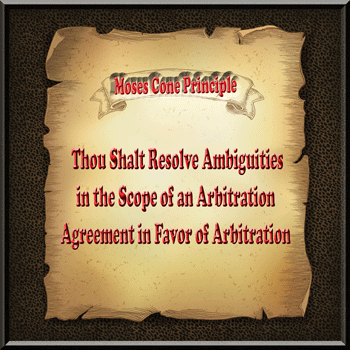
Back in 1983 the U.S. Supreme Court, in the landmark decision Moses H. Cone Memorial Hosp. v. Mercury Constr. Corp., 460 U.S. 1, 24-25 (1983), famously declared that “[t]he [Federal] Arbitration Act establishes that, as a matter of federal law, any doubts concerning the scope of arbitrable issues should be resolved in favor of arbitration, whether the problem at hand is the construction of the contract language itself or an allegation of waiver, delay, or a like defense to arbitrability.” 

Continue Reading »

Businessperson’s Federal Arbitration Act FAQ Guide II: Three Threshold Questions about the Federal Arbitration Act

January 21st, 2020 Arbitration Practice and Procedure, Businessperson's FAQ Guide to the Federal Arbitration Act, Convention on the Recognition and Enforcement of Foreign Arbitral Awards, FAA Chapter 1, FAA Chapter 2, FAA Chapter 3, FAA Preemption of State Law, Federal Arbitration Act Enforcement Litigation Procedure, Federal Arbitration Act Section 1, Federal Arbitration Act Section 2, Federal Arbitration Act Section 4, Federal Courts, Federal Question, Inter-American Convention on International Commercial Arbitration, New York Arbitration Law (CPLR Article 75), New York Convention, Nuts & Bolts: Arbitration, Panama Convention, Practice and Procedure, Rights and Obligations of Nonsignatories, Small Business B-2-B Arbitration, State Arbitration Law, State Arbitration Statutes, State Courts, United States Court of Appeals for the Second Circuit, United States Supreme Court 1 Comment »
Federal Arbitration Act | Arbitrator

This second instalment of the Businessperson’s Federal Arbitration Act FAQ Guide addresses three threshold questions pertinent to the Federal Arbitration Act (the “FAA” or “Federal Arbitration Act”):

1. Does Chapter 1 of the FAA apply to my arbitration agreement?

2. Assuming it does, will a federal district court have subject matter jurisdiction over FAA litigation concerning the agreement or any awards made under it?

3. Does the Federal Arbitration Act apply in state court?

Does Chapter 1 of the FAA Apply to My Arbitration Agreement?

If your written arbitration agreement is contained in a maritime contract or a contract affecting commerce, or concerns a dispute arising out of such a contract, then it falls under Chapter 1 of the Federal Arbitration Act, unless it falls within Section 1’s exemption for contracts of employment of transportation workers engaged in interstate commerce. (See here.) It may also fall under Chapters 2 or 3 of the FAA, which implement the New York and Panama Conventions.

In our first instalment of this FAQ guide (here) we explained that Federal Arbitration Act Section 2, as interpreted by the U.S. Supreme Court, applies to written, pre-dispute arbitration agreements in: (a) “maritime contract[s]” (“Maritime Contracts”); or (b) “contract[s] evidencing a transaction involving commerce. . . .” (“Contracts Affecting Commerce”). It also applies to written post-dispute arbitration agreements “to settle by arbitration a controversy thereafter arising out of such [Maritime Contracts or Contracts Affecting Commerce], or the refusal to perform the whole or any part thereof. . . .” 9 U.S.C. § 2; see Allied-Bruce Terminix Cos. v. Dobson, 513 U.S. 265, 273-282 (1995)Citizens Bank v. Alafabco, Inc., 539 U.S. 52, 55-58 (2003).

Section 2’s requirement that an arbitration agreement be “written” seems simple enough, and, for the most part, it is, at least in wholly domestic arbitrations to which Chapters 2 or 3 of the FAA do not concurrently apply. But there are some caveats.

First, just because a contract is required to be “written” doesn’t necessarily mean the arbitration agreement must be signed. The arbitration agreement between the parties need only be in writing, although the arbitration-agreement proponent would need to show that the parties assented to the writing.

For example, suppose A agrees to provide services for B and further agrees that any disputes arising out of or relating to their agreement will be submitted to arbitration. A and B proceed to memorialize their agreement in a writing, including the agreement to arbitrate, spelling out the essential terms of their agreement. While the writing is not signed or initialed, both parties agree that it reflects the essential terms of the parties’ bargain. The written memorialization of the agreement is sufficient to establish a “written” agreement, even though it is not signed by the party opposing its enforcement. 

Second, provided there is a written agreement between at least two parties,  persons who are not parties to that agreement (“nonparties”) may, in appropriate circumstances, enforce the agreement or be bound by it if general principles of state law permit that result. Such general principles include “‘assumption, piercing the corporate veil, alter ego, incorporation by reference, third-party beneficiary theories, waiver and estoppel[.] . . .’” . Arthur Andersen LLP v. Carlisle, 556 U.S. 624, 631 (2009) (citations omitted). This Term the United States Supreme Court is to determine whether such principles apply in cases governed by Chapter 2.

As respects whether a “contract” “evidenc[es] a transaction involving commerce,” the U.S. Supreme Court has interpreted Section 2 broadly to mean the Federal Arbitration Act applies to arbitration agreements in contracts or transactions that “affect” commerce, that is, to any contract or transaction that Congress could regulate in the full exercise of its Commerce Clause powers. See Allied-Bruce, 513 U.S. at 281-82; U.S. Const. Art. I, § 8, Cl. 3 (giving Congress power “to regulate commerce with foreign nations, and among the several states, and with the Indian tribes”).

Whether a contract “affects” commerce depends on the facts concerning, among other things, the parties, the contract’s subject matter, and the actual or contemplated transactions constituting the contract’s performance or contemplated performance. See Alafabco, 539 U.S. at 56-57. A party does not have to demonstrate that the contract has a “specific” or “substantial” “effect upon interstate commerce if in the aggregate the economic activity in question would represent a general practice subject to federal control.” Id. (citations and quotations omitted).  The question is whether the “aggregate economic activity in question” “bear[s] on interstate commerce in a substantial way.” Id. at 57.

Assuming that Chapter 1 of the FAA Applies to my Arbitration Agreement, Will a Federal District Court have Subject Matter jurisdiction over FAA Litigation Concerning the Agreement or any Awards Made under it?

Not necessarily. Unless an arbitration agreement also falls under Chapters 2 or 3 of the FAA, then there must be an independent basis for federal subject matter jurisdiction.

Continue Reading »

2018-2019 Term SCOTUS Arbitration Cases: What About Lamps Plus?

June 20th, 2019 Appellate Jurisdiction, Appellate Practice, Arbitration as a Matter of Consent, Arbitration Practice and Procedure, Class Action Arbitration, Clause Construction Award, Consent to Class Arbitration, Contract Interpretation, Contract Interpretation Rules, Drafting Arbitration Agreements, FAA Preemption of State Law, Federal Policy in Favor of Arbitration, United States Court of Appeals for the Ninth Circuit, United States Supreme Court 2 Comments »
Lamps Plus - Supreme Court Building
U.S. Supreme Court

On April 24, 2019 in Lamps Plus Inc. v. Varela, 587 U.S. ___, No. 17-998 (April 24, 2019), the United States Supreme Court considered whether whether consent to class arbitration may be inferred from ambiguous contract language.

In a 5-4 opinion written by Chief Justice John G. Roberts Jr. the Court held that ambiguity in and of itself was not enough to infer party consent to class arbitration. Parties would have to clearly express their consent to class arbitration before courts could impose it on them under the Federal Arbitration Act.

Continue Reading »

Class-Arbitration-Consent: The Eleventh Circuit Creates Circuit Split by Ruling that Incorporation of AAA Rules is Clear and Unmistakable Consent to Arbitrate Class-Arbitration-Consent Questions

August 24th, 2018 Arbitrability, Arbitration Agreements, Arbitration as a Matter of Consent, Arbitration Practice and Procedure, Authority of Arbitrators, Class Action Arbitration, Class Action Waivers, Consent to Class Arbitration, FAA Preemption of State Law, United States Court of Appeals for the Eleventh Circuit, United States Supreme Court Comments Off on Class-Arbitration-Consent: The Eleventh Circuit Creates Circuit Split by Ruling that Incorporation of AAA Rules is Clear and Unmistakable Consent to Arbitrate Class-Arbitration-Consent Questions

Introduction

Class-Arbitration-Consent 1

Class-Arbitration-Consent 1

In prior posts we’ve discussed how footnote 2 of the U.S. Supreme Court’s decision in Oxford Health Plans LLC v. Sutter, 133 S. Ct. 2064, 2072 n.2 (2013) said it was an open issue whether class-arbitration-consent presented a question of arbitrability, and how certain U.S. Circuit Courts of Appeals have, subsequent to Oxford, held that consent-to-class-arbitration presents a question of arbitrability, which is ordinarily for the court to decide. (See, e.g., here.)

We have also discussed how, under First Options of Chicago, Inc. v. Kaplan, 514 U.S. 938, 942-46 (1995), even though questions of arbitrability are ordinarily for the court to decide, parties may clearly and unmistakably agree to submit questions of arbitrability to the arbitrators. In Rent-A-Center, West, Inc. v. Jackson, 130 S. Ct. 2772, 2777 (2010), the Supreme Court of the United States referred to such agreements as “delegation provisions.” Id.

Class-Arbitration-Consent 2

Class-Arbitration-Consent 2

In Spirit Airlines, Inc. v. Maizes, ___ F.3d ___, slip op. (11th Cir. August 15, 2018), the United States Court of Appeals for the Eleventh Circuit addressed a question that called in to play these two related concepts: “whether the [parties’] agreement’s choice of American Arbitration Association rules, standing alone, is clear and unmistakable evidence that [the parties] intended that the arbitrator decide” the consent-to-class-arbitration question. Slip op. at 2. The Court said the answer to that question was “yes.”

Continue Reading »

Does the Presumption of Arbitrability Apply if a Contract Contains two Broad, Overlapping Forum Selection Clauses, one for Arbitration and one for Litigation?

June 7th, 2015 Arbitrability, Arbitration Agreements, Arbitration Practice and Procedure, Contract Interpretation, Contract Interpretation Rules, FAA Preemption of State Law, Federal Policy in Favor of Arbitration, Moses Cone Principle, Presumption of Arbitrability, Stay of Litigation, United States Court of Appeals for the Ninth Circuit Comments Off on Does the Presumption of Arbitrability Apply if a Contract Contains two Broad, Overlapping Forum Selection Clauses, one for Arbitration and one for Litigation?

Introduction

yay-4719842---Copy


Back in 1983 the U.S. Supreme Court, in the landmark decision Moses H. Cone Memorial Hosp. v. Mercury Constr. Corp., 460 U.S. 1, 24-25 (1983) (Brennan, J.), famously declared that “[t]he [Federal] Arbitration Act establishes that, as a matter of federal law, any doubts concerning the scope of arbitrable issues should be resolved in favor of arbitration, whether the problem at hand is the construction of the contract language itself or an allegation of waiver, delay, or a like defense to arbitrability.” Moses Cone thus established that there was a presumption in favor of arbitrability in cases governed by the Federal Arbitration Act, a conclusion that a number of other lower courts had previously reached, and which the Court had adopted about 23 years previously as a matter of federal labor law derived from Section 301 of the Labor Management Relations Act (sometimes referred to as the “Taft-Hartley Act”). See United Steel Workers of Am. v. Warrier & Gulf Nav. Co., 363 U.S. 574, 582-83 (1960) (Douglas, J.) (“An order to arbitrate the particular grievance should not be denied unless it may be said with positive assurance that the arbitration clause is not susceptible of an interpretation that covers the asserted dispute. Doubts should be resolved in favor of coverage.”)

The presumption of arbitrability is not a talismanic solution to every arbitration-law related problem. In fact it is designed to address only questions about the scope of an arbitration agreement.

The presumption has two related components. First, when courts construe the scope provision of an arbitration agreement to determine what merits-related issues the parties agreed to arbitrate, the court resolves ambiguities in favor of arbitration.  See, e.g., Mastrobuono v. Shearson Lehman Hutton, Inc., 514 U.S. 52, 62 (1995). Second, it presumes that procedural issues arising out of arbitrable disputes, and contract-related defenses to arbitrability—that is, “allegation[s] of waiver, delay and like defenses to arbitrability[,]” are presumptively for the arbitrator. See Moses Cone, 460 U.S. at 24-25; Howsam v. Dean Witter Reynolds, Inc., 537 U.S. 79, 84 (2002).

Roughly ten days ago, in a post about U.S. Circuit Judge Richard A. Posner’s Sprint Spectrum decision, we wrote about how some judges have interpreted the presumption too expansively:

The federal policy in favor of arbitration has, at least arguably, been interpreted to apply more expansively than the U.S. Supreme Court likely intended. As a result, even though the U.S. Supreme Court has said many times that arbitration is supposed to be a “matter of contract,” or one of “consent not coercion,” an overly expansive interpretation of the policy has, at least in some cases, arguably resulted in arbitration agreements being placed on a considerably more advantaged footing than ordinary contracts. As we read it, Judge Posner’s comment in Roughneck raises the question whether this might have more to do with “limit[ing] judicial workloads” than a desire to enforce contracts as written and according to their terms.

(Read our Sprint Spectrum post here.)

With all the hoopla about the presumption of arbitrability, one would think it very difficult to find a case that didn’t apply the presumption of arbitrability in a situation where it was supposed to apply it. In general that’s probably true, but on June 2, 2015 the U.S. District Court for the Western District of Washington proved that truth is not a universal one.

In Scolari v. Elliot Rust Co., No. C15-5163 (BHS), slip op. (W.D. Wash. June 2, 2015) the court considered whether ambiguity created by apparently conflicting forum selections clauses: one arbitral and two judicial. While the Court’s reasoning indicated that it considered the issue before it one of contract interpretation—the resolution of ambiguity—it nevertheless held that the ambiguity had to be resolved against the drafter of the contract, which the district court thought Washington law required, rather than in favor of arbitration, which was what federal law required. While it apparently recognized that application of the presumption, rather than a state-law contra proferentem rule, would have required the court to stay the litigation, it nevertheless denied the requested stay of litigation, concluding that the issue before it concerned the enforceability of the arbitration agreement, rather than an interpretation of its scope.

The net effect of the ruling was for the district court to implicitly have found that a judicial forum selection clause trumped an arbitral one, simply because they overlapped in scope, and that accordingly the arbitral forum selection clause was not enforceable. There was no legal basis for such a finding and the district court cited none.

The seriousness of the error was compounded by the district court’s acknowledgement that the arbitration proponent had advanced a reasonable interpretation of the arbitration agreement and judicial forum selection clauses, which harmonized them, and would have allowed arbitration to proceed, with the district court staying its hand in the interim. Instead of adopting that interpretation, it said that the arbitration challenger’s interpretation was likewise “reasonable,” but the court did not say what the challenger’s interpretation was, and given the disposition of the case, we assume that the “interpretation” was that the parties must not have intended to include a concededly existing and valid arbitration agreement in their agreement. But that interpretation not only ignored the presumption of arbitrability, but the general rule of contract interpretation that one contract provision not be construed to negate another.

We do not know whether the arbitration proponent preserved the argument for appeal, but there was another ground for a stay of litigation in this case that would have bypassed the issue of the presumption of arbitrability. The arbitration agreement contained a delegation clause, which clearly and unmistakably required the parties to submit to arbitration all disputes about arbitrability. Because there was no dispute about the existence or validity of the delegation clause, the Court should have held that the resolution of the apparent conflict between arbitral and judicial forum selection clauses was a question for the arbitrators.

If the arbitration proponent decides to appeal the decision, we hope that the U.S. Court of Appeals for the Ninth Circuit will correct these errors without delay, so that the parties can arbitrate their disputes, which is, after all, what they agreed to do.

Background

yay-12775922-digitalScolari v. Elliot Rust Co., No. C15-5163 (BHS), slip op. (W.D. Wash. June 2, 2015), arose out of the purchase, sale, termination and buyback of an interest in a limited liability company. Effective January 1, 2013 the plaintiff (the “Buyer”) purchased a ten-percent ownership interest in  Elliot Rust Companies, LLC (the “LLC”), the purchase and sale of which was governed by a “Grant Agreement” executed by the parties “according to the terms of [an] Amended and Restated LLC Agreement of Elliot Rust Companies, LLC dated January 1, 2013.” Both agreements were apparently part of the same transaction and were entered into at or about the same time.

The Buyer and LLC were the only parties to the Grant Agreement, which provided that the Buyer would acquire its 10% interest “according to the terms of the terms of the Amended and Restated LLC Agreement of Elliot Rust Companies, LLC dated January 1, 2013

The Grant Agreement provided, among other things, that:

[Scolari] understands, acknowledges and agrees that, upon execution of this Grant Agreement and the joinder to the LLC Agreement, [Scolari] shall, without further action or deed, thereupon be bound by the LLC Agreement, as it may thereafter be restated or amended, as though a direct signatory thereto.

It contained a “jurisdiction” clause that stipulated Washington law as governing and the U.S. District Court for the Western District of Washington as the exclusive judicial forum:

Governing Law: Jurisdiction. This Grant Agreement and the transaction contemplated hereby shall be governed by and construed according to the laws of the state of Washington. With respect to any dispute arising out of or related to this Grant Agreement or the LLC Agreement, the parties hereby consent to the exclusive jurisdiction of the United States District Court for the Western District of Washington. . . .

yay-1916763-digitalThe LLC Agreement, unlike the Grant Agreement, contained a broad arbitration agreement, which said:

Arbitration. All disputes, claims or controversies relating to this Agreement that are not resolved by mediation shall be submitted to final and binding arbitration. . . . Questions or arbitrability or the scope of the parties’ agreement to arbitrate shall be determined by the arbitrator.

But like the Grant Agreement, the LLC Agreement also contained a jurisdiction and venue clause:

Jurisdiction and Venue. Any suit involving any dispute or matter arising under this Agreement may only be brought in the United States District Court for the Western District of Washington or the Superior Court of Pierce County. All Members hereby consent to the exercise of personal jurisdiction by any such court with respect to any such proceeding.

The LLC terminated the plaintiff on November 6, 2014, and on December 15, 2014 offered to buy plaintiff’s 10% interest out for $158,882.60. The plaintiff refused the offer one week later, claiming that he did not believe it to be accurately valued.

yay-13760132Unable to agree a resolution the plaintiff filed suit in March 2015, requesting a judgment declaring he has a 20% interest in the profits of the LLC, and equitable relief.

The LLC moved on April 3, 2015 to dismiss for improper venue or to stay the action pending arbitration under Section 3 of the Federal Arbitration Act pending arbitration. The Court denied the motion.

The District Court’s Analysis and Conclusions

The Court began its analysis by acknowledging that its “role” was confined “‘to determining (1) whether a valid agreement to arbitrate exists and, if it does, (2) whether the agreement encompasses the dispute at issue.’” Slip op. at 4 (quoting Chiron Corp. v. Ortho Diagnostic Sys., Inc., 207 F.3d 1126, 1130 (9th Cir. 2000)). If the arbitration proponent establishes that the answers to both questions are “yes,” then, said the Court, the Court must “‘enforce the arbitration in accordance with its terms.’” Slip op. at 4 (quoting 207 F.3d at 1130). And in discussing the standard applicable to question (2), the Court, playing homage to the strong presumption in favor of arbitration, said “‘any doubts concerning the scope of arbitrable issues should be resolved in favor of arbitration. . . .’” Slip op. at 4 (quoting 207 F.3d at 1131).

So far, so good. But having accurately stated the governing rules, the Court inexplicably failed to heed them. Continue Reading »

SCOTUS Denies Americo and Jupiter Medical Cert. Petitions: All Eyes now on DIRECTV. . . .

May 19th, 2015 American Arbitration Association, Appellate Practice, Arbitrability, Arbitration Agreements, Arbitration as a Matter of Consent, Arbitration Practice and Procedure, Arbitration Provider Rules, Arbitrator Selection and Qualification Provisions, Awards, Choice-of-Law Provisions, Class Action Arbitration, Class Action Waivers, Confirmation of Awards, Consent to Class Arbitration, Contract Interpretation, FAA Preemption of State Law, Federal Arbitration Act Enforcement Litigation Procedure, Judicial Review of Arbitration Awards, State Courts, United States Supreme Court Comments Off on SCOTUS Denies Americo and Jupiter Medical Cert. Petitions: All Eyes now on DIRECTV. . . .

yay-34842-digital

On March 28, 2015 we reported (here) that the U.S. Supreme Court (“SCOTUS”) had asked for a response to the petition for certiorari in Americo Life, Inc. v. Myer, 440 S.W.3d 18 (Tex. 2014). In Americo the Texas Supreme Court held that an arbitration award had to be vacated because it was made by a panel not constituted according to the parties’ agreement. The parties’ agreement, among other things, incorporated the American Arbitration Association (the “AAA”)’s rules, which at the time the parties entered into the contract followed the traditional, industry arbitration rule that party-appointed arbitrators may be partial, under the control of the appointing party or both. But by the time the dispute arose the AAA Rules had been amended to provide that the parties are presumed to intend to require parties to appoint only neutral arbitrators—that is, arbitrators that are both impartial and independent.

Five Justices of the nine-member Texas Court determined that the parties had agreed that party-appointed arbitrators need not be impartial, only independent. Because the AAA had, contrary to the parties’ agreement, disqualified the challenging party’s first-choice arbitrator on partiality grounds, the panel that rendered the award was not properly constituted and thus exceeded its powers. See 440 S.W.3d at 25. (Copies of our Americo posts are here and here.)

yay-12776482As reported here and here, the losing party requested Supreme  Court review to determine whether the Texas Supreme Court should have deferred to the AAA’s decision on disqualification rather than independently determining whether the parties intended to require party-appointed arbitrators to be neutral. The petition argues that there is a split in the circuits on the issue.

On Monday, May 18, 2015, SCOTUS denied the petition for certiorari.  (You can access the Court’s May 18, 2015 Order List here.)

On Monday May 4, 2015, SCOTUS also denied the petition for certiorari in another Federal Arbitration Act case, Jupiter Medical Center, Inc. v. Visiting Nurse Assoc., No. 14-944, which was decided by the Florida Supreme Court. (You can access the Court’s May 4, 2015 Order List here.) Jupiter Medical Center, like Americo, concerned a post-award challenge under Section 10(a)(4) of the Federal Arbitration Act, and also like Americo, was decided by a state supreme court. In Jupiter Medical, however, the Florida Supreme Court rejected the post-award challenge.

yay-5257980-digitalSupreme Court watchers interested in arbitration cases will have to get their fix next term from DIRECTV v. Imburgia, which we discussed here. Will SCOTUS hold that the California intermediate Court did not give effect to the presumption of arbitrability? Will SCOTUS go even further and explain that, just as a statute cannot be interpreted “‘to destroy itself,'” AT&T Mobility LLC v. Concepcion, 131 S. Ct. 1740, 1748 (2011) (quoting  American Telephone & Telegraph Co. v. Central Office Telephone, Inc., 524 U.S. 214, 227-228 (1998) (quotation omitted)), so too cannot state law contract interpretation rules be applied in a way that would destroy an arbitration agreement to which the Federal Arbitration Act applies? Cf. Volt Info. Sciences, Inc. v. Trustees of Leland Stanford Junior Univ., 489 U.S. 468,  (1989) (“The question remains whether, assuming the choice-of-law clause meant what the Court of Appeal found it to mean, application of Cal. Civ. Proc. Code Ann. § 1281.2(c) is nonetheless pre-empted by the FAA to the extent it is used to stay arbitration under this contract involving interstate commerce.  .  .  . [because] “it would undermine the goals and policies of the FAA.”)

Stay tuned for DIRECTV.  .  .  .


Photo Acknowledgements:

All photos used in the text portion of this post are licensed from Yay Images and are subject to copyright protection under applicable law. Text has been added to image 2 (counting from top to bottom). Hover your mouse pointer over any image to view the Yay Images abbreviation of the photographer’s name.

U.S. Supreme Court Grants Certiorari in Another Class Arbitration Case: Can the Federal Arbitration Act Spare DIRECTV an Extended Stay in Class-Arbitration-Waiver Purgatory?

March 31st, 2015 Appellate Practice, Arbitrability, Arbitration Agreements, Arbitration Practice and Procedure, California State Courts, Choice-of-Law Provisions, Class Action Arbitration, Class Action Waivers, Contract Interpretation, FAA Preemption of State Law, Practice and Procedure, State Courts, United States Supreme Court Comments Off on U.S. Supreme Court Grants Certiorari in Another Class Arbitration Case: Can the Federal Arbitration Act Spare DIRECTV an Extended Stay in Class-Arbitration-Waiver Purgatory?

On March 23, 2015 the U.S. Supreme Court granted certiorari in DIRECTV, Inc. v. Imburgia, No. 14-462. If decided on its merits, the case will be by our count the fifth U.S. Supreme Court decision concerning class arbitration decided on its merits during the period 2010 forward.

yay-1341284-digitalImburgia is a decision by the California Court of Appeals, Second District, Division One of which the California Supreme Court denied review. Like many other Federal Arbitration Act cases, it presents some interesting vertical conflict of law questions, but the California Court of Appeals does not appear to have resolved them in the way the U.S. Supreme Court presumably intended them to be resolved under the Volt and Mastrobuono lines of cases. 

The case centers  on a class-action waiver non-severability provision included in a consumer contract DIRECTV entered into in 2007, about four years before the U.S. Supreme Court ruled in Concepcion that the Federal Arbitration Act preempted California’s Discover Bank rule. The Discover Bank rule provides that class action waivers are unenforceable in litigation or arbitration proceedings. See, generally, AT&T Mobility LLC v. Concepcion, 131 S.Ct. 1740, 1753 (2011).

yay-3535433-digitalBefore Concepcion not only did the California state courts hold that the Federal Arbitration Act did not preempt the Discover Bank rule, but so did the U.S. Court of Appeals for the Ninth Circuit. Thus, at the time, the risk companies like DIRECTV and others with consumer class arbitration exposure had was that applicable state law would not only ban class arbitration waivers, but applicable federal law would permit that to happen.

So companies like DIRECTV and others built into their arbitration agreements a fail-safe mechanism under which the entire arbitration agreement would be rendered uneneforceable if state law rendered the class arbitration waiver unenforceable. In other words, the companies understandably viewed class action litigation to be a more favorable alternative than class arbitration if forced to choose between the two. Continue Reading »

What Standards Apply to Lance Armstrong’s Putative Challenge to the $10,000,000.00 Arbitration Award?

March 1st, 2015 Arbitrability, Arbitration Agreements, Arbitration Practice and Procedure, Authority of Arbitrators, Choice-of-Law Provisions, Contract Interpretation, Convention on the Recognition and Enforcement of Foreign Arbitral Awards, FAA Preemption of State Law, Judicial Review of Arbitration Awards, New York Convention, Practice and Procedure, State Courts, Texas Supreme Court, United States Supreme Court Comments Off on What Standards Apply to Lance Armstrong’s Putative Challenge to the $10,000,000.00 Arbitration Award?

SCA v. Armstrong:

Anatomy of an Arbitration Award—Part II

What Standards Apply to Lance Armstrong’s Putative Challenge to the Arbitrators’ $10,000,000.00 Sanctions Award?


yay-10447276-digitalAs discussed in Part I, if Lance Armstrong (“Armstrong”) and Tailwind Sports Corp. (“Tailwind”) (collectively, the “Armstrong Parties”) challenge the Armstrong Arbitration Award, that challenge will be based on the Panel allegedly exceeding its powers. To meaningfully assess whether the Panel exceeded its powers we need to consider what law applies. Continue Reading »