Archive for the ‘Arbitrability’ Category

Circuit Court Judge Richard A. Posner Weighs in on Federal Policy in Favor of Arbitration

May 23rd, 2015 Appellate Practice, Arbitrability, Arbitration Agreements, Arbitration as a Matter of Consent, Arbitration Practice and Procedure, Class Action Waivers, Contract Interpretation, Federal Arbitration Act Enforcement Litigation Procedure, Federal Policy in Favor of Arbitration, Labor Arbitration, Practice and Procedure, Presumption of Arbitrability, United States Court of Appeals for the Seventh Circuit, United States Supreme Court Comments Off on Circuit Court Judge Richard A. Posner Weighs in on Federal Policy in Favor of Arbitration

Introduction

Ronald v. Sprint Spectrum L.P., No. 14-3478, slip op. (7th Cir. May 11, 2015) (Posner, J.)

Ronald v. Sprint Spectrum L.P., No. 14-3478, slip op. (7th Cir. May 11, 2015) arose out of a class action lawsuit brought in the U.S. District Court for the Northern District of Illinois by a putative class of mobile phone customers—represented by Mr. and Ms. Andermann (the “Andermanns”)—against Sprint, which sought damages for alleged violations of the Telephone Consumer Protection Act, 47 U.S.C. § 227.

Sprint moved to compel arbitration, but the district court denied its motion. Sprint appealed to the U.S. Court of Appeals for the Seventh Circuit as authorized by 9 U.S.C. § 16(a)(1)(B). The Seventh Circuit, in an opinion written by Circuit Judge Richard A. Posner, and joined in by Circuit Judge Diane S. Sykes and Chief District Court Judge Philip P. Simon of the Northern District of Indiana (sitting by designation), reversed and remanded with instructions to compel arbitration.

The Sprint Spectrum facts; the legal rules and principles that determined the outcome; and the outcome itself were not controversial.  Had the court limited its task to applying the material facts to the applicable law, then the case likely would not have warranted a reported opinion.

But occasionally appellate judges, particularly ones as prominent, skilled and engaged as Judge Posner, will use a case like Sprint to make a point in passing that might influence other judges in the future and perhaps provide valuable information to attorneys and their clients. Judge Posner, with the apparent blessing of the other two judges, used the case to make a couple of points, one purely legal, the other bearing on both the law and, and at least to some extent, on matters pertinent to court administration.

The purely legal issue concerned the  proper scope and practical significance of the federal policy in favor of arbitration, which a majority of the U.S. Supreme Court, Judge Posner and some other judges apparently believe lawyers and judges may misunderstand or misinterpret. In Sprint Spectrum Judge Posner, in dictum, raises the topic and shares some important insights about it.

The hybrid legal and judicial administration point concerned his view of the merits of the underlying Telephone Consumer Protection Act dispute.  While the Court acknowledged that it was for the arbitrators to decide the merits, it nevertheless explained why it believed the claim would likely fail, whether in arbitration or in court.

Sprint Spectrum: Background

yay-985888-digital---CopyIn 2000 the Andermanns entered into a two-year renewable mobile-phone service contract with U.S. Cellular, which was renewed continuously, and for the last time in 2012. The contract contained an arbitration agreement requiring arbitration of “any controversy or claim arising out of or relating to this agreement.” The parties agreed that the obligation to arbitrate would “survive[] the termination of [the] [mobile phone] service agreement[,]” and that “U.S. Cellular may assign this Agreement without notice to” the customer.

In 2013 U.S. Cellular sold the contract to Sprint, and notified the Andermanns of the sale in a letter sent months later. The letter informed the Andermanns that their service would be terminated effective January 2014  because of a compatibility problem between the Andermann’s mobile phone and the Sprint network. The letter explained that the Andermanns would have to obtain a new cell phone or find a new carrier, but “that Sprint was offering attractive substitutes for the terminated service,” and, if interested, the customer should contact Sprint by telephone. See slip op. at 2.

In December Sprint phoned the Andermanns to remind them that their service was about to expire, and added that Sprint had “a great set of offers and devices available to fit [their] needs.'” Slip op. at 3. Sprint called each of three members of the Andermann family twice (a total of six calls), but by the time the calls were made, the Andermanns had obtained cell phone service from another carrier.

yay-10331162-digitalThe Andermanns did not answer any of the six calls, except by commencing a class action lawsuit against Sprint, which contended that the unsolicited calls violated the Telephone Consumer Protection Act. Sprint moved to compel arbitration, contending that the dispute arose out of and related to the contract renewed in 2012. Even though that contract was between U.S. Cellular and the Andermanns, U.S. Cellular had, as permitted by the contract, assigned its rights to Sprint, who had now stepped into U.S. Cellular’s shoes under the contract.

The Seventh Circuit’s Decision

The district court denied Sprint’s motion because its contract with the Andermanns had terminated prior to the allegedly offending telephone calls at issue in the lawsuit. The district court reasoned that the dispute did  not arise out of or relate to the terminated agreement.

But the Court  said “[a]ctually, there’s an intimate relation” between the dispute and the contract. “The contract,” said the Court, authorized an assignment, and because of the incompatibility of the assignor’s (U.S. Cellular’s) cellphones and the assignee’s (Sprint’s) mobile phone network, Sprint had had to terminate the U.S. Cellular customers, such as the Andermanns, whom it had acquired by virtue of the assignment.  .  .  .” Slip op. 4. Sprint made the calls, and “offer[red] substitute service[]”  “to prevent the loss of.  .  .  customers because of the incompatibility.  .  .  .” Slip op. at 4.

yay-10348120-digitalThe Andermanns attempted to support their argument by offering an “untenable interpretation” of Smith v. Steinkamp, 318 F.3d 775, 777 (7th Cir. 2003). See Slip op. at 4. Steinkamp explained “‘absurd results’ would ensue if the arising from and relating to provisions contained in a payday loan agreement defining what disputes would have to arbitrated rather than litigated, were cut free from the loan and applied to a subsequent payday loan agreement that did not contain those provisions.” Slip op. at 4-5 (quoting Steinkamp, 318 F.3d at 777).

The Andermanns argued that Steinkamp suggested that the same type of “absurd results” would ensue under the facts of this case. But Steinkamp, explained the Court, “is not this case[,]” which concerns a single contract containing an arbitration agreement, not two successive contracts, one with an arbitration agreement and one without an arbitration agreement. See slip op. at 5.

yay-2220659-digitalWhile the Andermanns received a mild (and perhaps well-deserved) rebuke, Sprint’s argument prompted the verbal version of a roll of the eyes coupled with a quiet sigh—not so much because there was anything really wrong with the argument, but presumably because it overstated the importance of the federal policy in favor of arbitration. But that gave Judge Posner an opportunity to make a somewhat subtle, but important point.

The Court  said “Sprint gilds the lily, however, in telling us that arbitration is a darling of federal policy, that there is a presumption in favor of it, that ambiguities in an arbitration clause should be resolved in favor of arbitration, and on and on in this vein.” Slip op. at 5. “It’s true,” said the Court, “that such language (minus the “darling”) appears in numerous cases.” Slip op. at 5 (citations omitted): “But the purpose of that language is to make clear, as had seemed necessary because of judges’ historical hostility to arbitration, that arbitration was no longer to be disfavored — especially in labor cases, see, e.g., Granite Rock Co. v. International Brotherhood of Teamsters, 561 U.S. 287, 298­-99 (2010), where arbitration is now thought a superior method of dispute resolution to litigation.” Slip op. at 5.

Noting that “[t]he Federal Arbitration Act is inapplicable to labor disputes,  .  .  . and merely makes clauses providing for the arbitration of disputes arising out of transactions involving interstate or foreign commerce.  .  . enforceable in federal and state courts[,]” the Court said it was “not clear that arbitration, which can be expensive because of the high fees charged by some arbitrators and which fails to create precedents to guide the resolution of future disputes, should [in commercial cases] be preferred to litigation.” Slip op. at 5-6. Continue Reading »

SCA v. Armstrong: Anatomy of the Lance Armstrong Arbitration Award—Part III.B.4: The Panel’s Remedial Authority

May 20th, 2015 Arbitrability, Arbitration Agreements, Arbitration Provider Rules, Attorney Fees and Sanctions, Authority of Arbitrators, Awards Comments Off on SCA v. Armstrong: Anatomy of the Lance Armstrong Arbitration Award—Part III.B.4: The Panel’s Remedial Authority

Introduction: Remedial Powers of Arbitrators under the Federal Arbitration Act

yay-1617269-digital2copy_edited-1

The third issue the Armstrong Panel addressed was: “What jurisdiction, if any, does this Tribunal have to award sanctions?” This was a question of the Panel’s remedial authority — assuming the Panel had the authority to decide the dispute, what remedies were the arbitrators authorized to award?

The Panel determined that Armstrong had committed fraud and testified falsely, and had by those unlawful means procured the Settlement Agreement and Consent Award. All else equal, had the Armstrong Parties testified truthfully, and been prepared to do so from the outset of the dispute, then presumably the Armstrong Parties: (a) would not have claimed the $7.5 million in prize money; or (b) would have submitted to arbitration the question whether the Armstrong Parties’ use of performance enhancing drugs barred them from recovering the prize money under their contracts with the SCA Parties. If the Armstrong Parties chose option (a) above, then the SCA Parties would not have incurred any time or money costs dealing with the Armstrong Parties’ Claims. Had the Armstrong Parties chosen option (b), then the SCA Parties’ time and money costs would likely have been pretty modest, and in any event, nowhere near what they turned out to be.

Given that the Panel identified a breach of duty that caused harm, the next question from the standpoint of the merits was: what (if anything) should be the remedy? The SCA parties apparently argued that the Panel should grant a sanctions remedy, which the Panel apparently viewed as serving both deterrent and compensatory purposes.

Where, as here, an arbitration panel that has the authority to resolve a dispute is considering what relief (if any) it should award to the prevailing party, that raises a remedial authority question: what remedies have the parties authorized the Panel to award? Under a broad arbitration agreement, remedial authority questions are typically not controversial, for parties ordinarily tend to seek standard remedies: damages, declaratory relief or traditional forms of equitable relief (such as rescission or reformation).  One party asks for the relief in its submission in the arbitrators and the other party doesn’t object because there is no reason to do so.

But where other non-standard forms of relief are requested—and particularly where the parties’ contract express a clear intent to limit remedial powers—then remedial authority can become more controversial.

The Armstrong Arbitration involved a claim for sanctions arising in unusual circumstances. While the parties’ contracts did not purport to limit the Panel’s remedial authority, the Armstrong Parties challenged the Panel’s authority to award sanctions and the Panel addressed that challenge in a reasoned award.

This segment of our Armstrong-Award Anatomy series focuses exclusively on whether the Panel had the authority to make an award of sanctions. It reviews the general rules concerning arbitrator remedial authority, considers the standard of review that a court reviewing the award will presumably apply if the Armstrong Parties contest the Panel’s remedial authority in court, discusses the Panel’s analysis and conclusions concerning sanctions and explains why we think it unlikely that a court will find that the Panel exceeded its authority by making an award of sanctions.

Our next Armstrong Arbitration Award Anatomy segment will address the related—but analytically distinct—issue whether the Panel had the authority to make a $10,000,000.00 sanctions award in the circumstances.

General Rules Governing Arbitrator Remedial Authority

yay-974131-e1425250054241As a general rule, where the parties have agreed to require each other to submit to arbitration a broad range of a disputes that might arise out of or relate to their legal relationship, the law presumes they intended to confer equally broad remedial powers on the arbitrators. See, e.g., ReliaStar Life Ins. Co. v. EMC Nat’l Life Co., 564 F.3d 81, 86-87 (2d Cir. 2009) (citing cases). Sometimes, arbitration-provider rules—such as Rule 47 of the American Arbitration Association Commercial Rules (formerly Rule 43)—expressly confer broad remedial authority on arbitrators. Rule 47, for example, states: Continue Reading »

SCOTUS Denies Americo and Jupiter Medical Cert. Petitions: All Eyes now on DIRECTV. . . .

May 19th, 2015 American Arbitration Association, Appellate Practice, Arbitrability, Arbitration Agreements, Arbitration as a Matter of Consent, Arbitration Practice and Procedure, Arbitration Provider Rules, Arbitrator Selection and Qualification Provisions, Awards, Choice-of-Law Provisions, Class Action Arbitration, Class Action Waivers, Confirmation of Awards, Consent to Class Arbitration, Contract Interpretation, FAA Preemption of State Law, Federal Arbitration Act Enforcement Litigation Procedure, Judicial Review of Arbitration Awards, State Courts, United States Supreme Court Comments Off on SCOTUS Denies Americo and Jupiter Medical Cert. Petitions: All Eyes now on DIRECTV. . . .

yay-34842-digital

On March 28, 2015 we reported (here) that the U.S. Supreme Court (“SCOTUS”) had asked for a response to the petition for certiorari in Americo Life, Inc. v. Myer, 440 S.W.3d 18 (Tex. 2014). In Americo the Texas Supreme Court held that an arbitration award had to be vacated because it was made by a panel not constituted according to the parties’ agreement. The parties’ agreement, among other things, incorporated the American Arbitration Association (the “AAA”)’s rules, which at the time the parties entered into the contract followed the traditional, industry arbitration rule that party-appointed arbitrators may be partial, under the control of the appointing party or both. But by the time the dispute arose the AAA Rules had been amended to provide that the parties are presumed to intend to require parties to appoint only neutral arbitrators—that is, arbitrators that are both impartial and independent.

Five Justices of the nine-member Texas Court determined that the parties had agreed that party-appointed arbitrators need not be impartial, only independent. Because the AAA had, contrary to the parties’ agreement, disqualified the challenging party’s first-choice arbitrator on partiality grounds, the panel that rendered the award was not properly constituted and thus exceeded its powers. See 440 S.W.3d at 25. (Copies of our Americo posts are here and here.)

yay-12776482As reported here and here, the losing party requested Supreme  Court review to determine whether the Texas Supreme Court should have deferred to the AAA’s decision on disqualification rather than independently determining whether the parties intended to require party-appointed arbitrators to be neutral. The petition argues that there is a split in the circuits on the issue.

On Monday, May 18, 2015, SCOTUS denied the petition for certiorari.  (You can access the Court’s May 18, 2015 Order List here.)

On Monday May 4, 2015, SCOTUS also denied the petition for certiorari in another Federal Arbitration Act case, Jupiter Medical Center, Inc. v. Visiting Nurse Assoc., No. 14-944, which was decided by the Florida Supreme Court. (You can access the Court’s May 4, 2015 Order List here.) Jupiter Medical Center, like Americo, concerned a post-award challenge under Section 10(a)(4) of the Federal Arbitration Act, and also like Americo, was decided by a state supreme court. In Jupiter Medical, however, the Florida Supreme Court rejected the post-award challenge.

yay-5257980-digitalSupreme Court watchers interested in arbitration cases will have to get their fix next term from DIRECTV v. Imburgia, which we discussed here. Will SCOTUS hold that the California intermediate Court did not give effect to the presumption of arbitrability? Will SCOTUS go even further and explain that, just as a statute cannot be interpreted “‘to destroy itself,'” AT&T Mobility LLC v. Concepcion, 131 S. Ct. 1740, 1748 (2011) (quoting  American Telephone & Telegraph Co. v. Central Office Telephone, Inc., 524 U.S. 214, 227-228 (1998) (quotation omitted)), so too cannot state law contract interpretation rules be applied in a way that would destroy an arbitration agreement to which the Federal Arbitration Act applies? Cf. Volt Info. Sciences, Inc. v. Trustees of Leland Stanford Junior Univ., 489 U.S. 468,  (1989) (“The question remains whether, assuming the choice-of-law clause meant what the Court of Appeal found it to mean, application of Cal. Civ. Proc. Code Ann. § 1281.2(c) is nonetheless pre-empted by the FAA to the extent it is used to stay arbitration under this contract involving interstate commerce.  .  .  . [because] “it would undermine the goals and policies of the FAA.”)

Stay tuned for DIRECTV.  .  .  .


Photo Acknowledgements:

All photos used in the text portion of this post are licensed from Yay Images and are subject to copyright protection under applicable law. Text has been added to image 2 (counting from top to bottom). Hover your mouse pointer over any image to view the Yay Images abbreviation of the photographer’s name.

All Eyes on Americo. . . .SCOTUS Expected to Rule on Petition for Certiorari at Upcoming May 14, 2015 Conference

May 12th, 2015 American Arbitration Association, Appellate Practice, Arbitrability, Arbitration Agreements, Arbitration as a Matter of Consent, Arbitration Practice and Procedure, Arbitration Provider Rules, Arbitrator Selection and Qualification Provisions, Awards, Confirmation of Awards, Contract Interpretation, Evident Partiality, Judicial Review of Arbitration Awards, State Courts Comments Off on All Eyes on Americo. . . .SCOTUS Expected to Rule on Petition for Certiorari at Upcoming May 14, 2015 Conference

yay-677327-digitalOn March 28, 2015 we reported (here) that the U.S. Supreme Court had asked for a response to the petition for certiorari in Americo Life, Inc. v. Myer, 440 S.W.3d 18 (Tex. 2014). In Americo the Texas Supreme Court held that an arbitration award had to be vacated because it was made by a panel not constituted according to the parties’ agreement. The parties’ agreement, among other things, incorporated the American Arbitration Association (the “AAA”)’s rules, which at the time the parties entered into the contract followed the traditional, industry arbitration principle that party-appointed arbitrators may be partial, under the control of the appointing party or both. But by the time the dispute arose the AAA Rules had been amended to provide that the parties are presumed to intend that appointed arbitrators must be neutral.

Five Justices of the nine-member Court determined that the parties had agreed that party-appointed arbitrators need not be impartial, only independent. Because the AAA had, contrary to the parties’ agreement, disqualified the challenging party’s first-choice arbitrator on partiality grounds, the panel that rendered the award was not properly constituted and thus exceeded its powers. See 440 S.W.3d at 25. (Copies of our Americo posts are here and here.)

yay-34842-e1424841353823The losing party is requesting Supreme  Court review to determine whether the Texas Supreme Court should have deferred to the AAA’s decision on disqualification rather than independently determining whether the parties intended to require party-appointed arbitrators to be neutral. The petition argues that there is a split in the circuits on the issue.

At this week’s May 14, 2015 conference, the Court will presumably decide whether or not to grant certiorari.

In our March 28, 2015 post (here) we argued  that Americo‘s unique facts make it poor candidate for certiorari. At the time the parties agreed to arbitrate, the AAA rules “provided that ‘[u]nless the parties agree otherwise, an arbitrator selected unilaterally by one party is a party-appointed arbitrator and not subject to disqualification pursuant to Section 19.'” 440 S.W.3d at 23 (quoting AAA Commercial Rule § 12 (1996)). Section 19 permitted the AAA to disqualify neutral arbitrators for partiality, but, under Section 12, absent an agreement to the contrary, party-appointed arbitrators were not subject to disqualification under Rule 19. When the AAA Rules were amended to reverse the traditional presumption about partiality of party-appointed arbitrators, the Rules were also amended to authorize the AAA to determine whether party-appointed arbitrators were neutral.

yay-8590418-digitalThis is one of those (relatively rare) cases where a question of arbitrability—that is, whether the parties agreed to delegate to the AAA the authority to make a final and binding determination on whether a party-appointed arbitrator may be disqualified—is intertwined so inextricably with the merits of the dispute alleged to be arbitrable that, for all intents and purposes, the arbitrability and merits questions are identical. In other words, the AAA’s authority to disqualify turns on whether the parties agreed to neutral or non-neutral party-appointed arbitrators–the precise issue the petition claims the AAA should itself decide. In situations like these, the court cannot abdicate its duty to determine arbitrability, even if that means deciding some or all of the disputes that are alleged to be arbitrable. See, generally, Litton Financial Printing Div. v. National Labor Relations Board, 501 U.S. 190, 208-09 (1991).

Of course, the Supreme Court may believe otherwise, or may have other reasons for wanting  to grant certiorari.  But in any event, we’ll probably know by Monday, May 18, 2015 whether the Court will take the case.


Photo Acknowledgements:

All photos used in the text portion of this post are licensed from Yay Images and are subject to copyright protection under applicable law. Text has been added to images 1 and 3 (counting from top to bottom). Hover your mouse pointer over any image to view the Yay Images abbreviation of the photographer’s name.

Can a Court Order a Party not to Request in Arbitration a Remedy the Arbitrator may not have the Authority to Grant?

May 10th, 2015 Arbitrability, Arbitration Practice and Procedure, Authority of Arbitrators, Awards, Federal Arbitration Act Enforcement Litigation Procedure, Federal Courts, Injunctions in Aid of Arbitration, Practice and Procedure, United States Court of Appeals for the Second Circuit Comments Off on Can a Court Order a Party not to Request in Arbitration a Remedy the Arbitrator may not have the Authority to Grant?

Can a Court Forbid a Party from Requesting in Arbitration a Remedy the Arbitrator may not Have the Authority to Grant?

Benihana Case: Introduction

yay-1463751-digital

In appropriate circumstances, Courts can vacate under Federal Arbitration Act Section 10(a)(4) an award that does not draw its essence from the parties’ agreement but instead was based on the arbitrators’ own notions of economic justice.

In Benihana, Inc. v. Benihana of Tokyo, LLC, ___ F.3d ___, No. 14-841, slip op. (2d Cir. April 28, 2015), the U.S. Court of Appeals for the Second Circuit  was faced with a different issue: whether before an award was made a court can enjoin a party from asking the arbitrators to award it a remedy that the parties’ contract does not authorize them to award.

The Court quite correctly ruled that district  courts do not  have the discretion to grant such an injunction because, among other things, doing so would violate the Federal Arbitration Act by infringing upon the parties’ agreement to arbitrate. In so holding the court was able to clarify a misunderstanding about arbitrability that is all too common among lay persons, a number of lawyers and apparently even the occasional judge.

Benihana Case: Background

yay-594165-digital

Benihana, Inc. (“Benihana U.S.”) and Beni-Hana of Toky (“Benihana Tokyo”)  were parties to a 1995 licensing agreement, which granted Benihana Tokyo the right to open Benihana restaurants in Hawaii. The agreement contained a New York choice of law clause.

yay-1557903The licensing agreement was designed, among other things, to require Benihana of Tokyo’s Hawaii restaurants to conform with Benihana standards, including those applicable to the menu and the use of Benihana trademarks. The Agreement, for example, required written approval by Benihana U.S. of “products and services” to be sold by Beni-Hana Tokyo, and stipulated that approval would “not be unreasonably withheld.”

The licensing agreement’s termination provisions provided that Benihana U.S. could terminate Benihana Tokyo’s license for good cause in the event of a “violation of ‘any substantial term or condition of th[e] Agrement [that Benihana Tokyo] fails to cure. .  . within thirty days after written notice from [Benihana U.S.].” Three cured defaults within a 12 month period also constituted good cause.

The Agreement contemplated both arbitration and injunctions in aid of arbitration (i.e., to preserve the status quo) as respects “violation of certain articles— including Article 5.2 restricting Benihana of Tokyo’s trademark use and Article 8.1(c) restricting the items Benihana of Tokyo may advertise or sell.  .  .  .” The injunctive-relief provisions specified that violations of those articles “would result in irreparable injury to [Benihana U.S.] for which no adequate remedy at law may be available. . . .”  They also  stipulated that Benihana U.S. “may obtain ‘an injunction against [such] violation . . . without the necessity of showing actual or threatened damage.'”

yay-1916763-digitalArticle 13 of the Agreement provided for arbitration in two types of situations. First, disputes about termination of the Agreement were subject to mandatory arbitration:

If this Agreement shall be terminated by [Benihana U.S.] and [Benihana of Tokyo] shall dispute [Benihana U.S.’s] right of termination, or the reasonableness thereof, the dispute shall be settled by arbitration at the main office of the AmericanArbitration Association in the City of New York in accordance with the rules of said association and judgment upon the award rendered by the arbitrators may be entered in any court having jurisdiction thereof. The arbitration panel shall consist of three (3) members, one (1) of whom shall be chosen by [Benihana U.S.], and (1) by [Benihana Tokyo] and the other by the two (2) so chosen.

Slip op. at 7.

Second, the agreement contained a broad, catchall provision that provided for arbitration of “any other dispute” at the election of either party:

In the event that any other dispute arises between the parties hereto in connection with the terms or provisions of this Agreement, either party by written notice to the other party may elect to submit the dispute to binding arbitration in accordance with the foregoing procedure. Such right shall not be exclusive of any other rights which a party may have to pursue a course of legal action in an appropriate forum. Enforcement of any arbitration  award, decision or order may be sought in any court having competent jurisdiction.

Slip op. at 7.

yay-10331162-digitalDuring the period 1995 until 2012 the parties enjoyed an amicable contractual relationship, but after a 2012 sale of Benihana U.S. to Angelo Gordon & Co., disputes started to arise. In May 2013 Benihana U.S., now under new ownership, notified Benihana Tokyo that: (a) Benihana U.S. had learned that Benihana Tokyo was selling “BeniBurgers” (a type of hamburger) at its Honolulu restaurant; (b) the licensing agreement required that new menu items be approved by Benihana U.S.; and (c) Benihana U.S. had not approved the sale of “BeniBurgers.” Benihana U.S. demanded that Benihana Tokyo remove BeniBurgers from the menu.

Benihana Tokyo did not remove BeniBurgers from the menu, which prompted Benihana U.S. to declare a breach of contract and notify Benihana Tokyo that it had 30 days to cure. Benihana U.S. extended the cure period twice, and Benihana Tokyo commenced  an action in New York State Supreme Court for an injunction staying the cure period pending arbitration of the parties’ dispute about BeniBurgers. Continue Reading »

The Fifth Circuit’s PoolRe Decision: Captives, Insurance, Reinsurance, Arbitration, Multiple Parties, Multiple Contracts, Conflicting Arbitration Agreements: Does it Get any Better than this?!

April 17th, 2015 Appellate Practice, Arbitrability, Arbitration Agreements, Arbitration as a Matter of Consent, Arbitration Practice and Procedure, Arbitration Provider Rules, Arbitration Risks, Arbitrator Selection and Qualification Provisions, Authority of Arbitrators, Awards, Captive Insurance Companies, Confirmation of Awards, Consolidation of Arbitration Proceedings, Contract Interpretation, Dispute Risk - Frequency and Severity, Drafting Arbitration Agreements, Federal Courts, Grounds for Vacatur, Making Decisions about Arbitration, Managing Dispute Risks, Outcome Risk, Practice and Procedure, Reinsurance Arbitration, Small and Medium-Sized Business Arbitration Risk, Small Business B-2-B Arbitration, United States Court of Appeals for the Fifth Circuit Comments Off on The Fifth Circuit’s PoolRe Decision: Captives, Insurance, Reinsurance, Arbitration, Multiple Parties, Multiple Contracts, Conflicting Arbitration Agreements: Does it Get any Better than this?!

Part I: PoolRe Introduction and Background

 Introduction

yay-4463438-digitalArbitration offers rough justice on the merits. Arbitrators have broad discretion not only in deciding the dispute but in fashioning remedies. Skilled, experienced and responsible arbitrators can cut through all sorts of legal and contractual “red tape” to resolve a dispute, applying just enough gloss on the law and the contract to make things work in a businesslike fashion while remaining true to the “essence of the agreement.”  Applied just so, that kind of rough justice is sometimes exactly what the parties need to make their agreement work, and in some cases, preserve (or even improve) their commercial relationship going forward. And it is not something that Court adjudication necessarily—or even ordinarily—can achieve.

But rough justice does not govern whether the parties agreed to arbitrate, who’s bound by an arbitration agreement and whether the parties agreed to delegate authority to a particular arbitrator or to follow a particular method of arbitrator selection as set forth in the parties’ agreement. Those questions are governed principally by state contract law and—particularly when multiple agreements and multiple parties are involved, or the question concerns whether an arbitrator was validly appointed—they frequently must be decided by courts, even if some or all of the parties have clearly and unmistakably agreed to submit arbitrability questions to arbitration.

Details, Details.  .  .

yay-12799824-digital

Details always matter, but they are all the more important when a dispute will presumably be decided under state contract law rules and principles by a decision maker whose decisions—unlike those of an arbitrator—are often subject to independent review by an appellate court. Courts generally do not (or at least are not supposed to) substitute rough justice, pragmatism or equity in place of contract law, which is not always so flexible. The casebooks are littered with examples where doing so might arguably have achieved a more desirable outcome but doing so could not be squared with contract rules and principals in a way that befitted higher-court precedent and the circumstances apparently did not warrant departure from precedent.

The U.S. Court of Appeals for the Fifth Circuit’s decision in PoolRe Ins. Corp. v. Organizational Strategies, Inc., No. 14-20433, slip op. (5th Cir. April 7, 2015), is a case where the parties apparently lost sight of some important details in their apparent haste to do a deal that unfortunately went sour. Then, an arbitrator appointed under one of the contracts compounded the problem by making an award that could not even arguably be squared with the clear terms of one of the contracts’ arbitration agreements.


yay-5714244-digital


The parties that were probably best positioned to ensure that the arbitration agreements in the various service-provider and reinsurance contracts probably lost the most, and perhaps to some extent at least, there’s some poetic justice to that. They claimed the clients breached their service contracts, the clients said the service providers breached the contracts and independent legal duties and the arbitrator ruled in favor of the service providers. The district court, as we’ll see, properly vacated the award and the Fifth Circuit affirmed.  Now the parties are essentially back at square one, albeit much worse for the wear in terms of legal expenses and protracted delay.

The facts and procedural history of the case is somewhat complex, but critically important. Not only do they drive the outcome but they read like a primer on what not to do when attempting to devise a cost-effective arbitration program for disputes that may involve multiple parties and interrelated and interdependent contracts. And they demonstrate pretty starkly some of the consequences that parties can suffer when: (a) they do not properly structure their agreement; and (b) end up with an arbitrator who is not be as savvy as he or she might otherwise be about scope of authority (or simply makes a bad call about it).

We do not mean to suggest that the Arbitrator in this case was in any way incompetent or otherwise blameworthy. To err is human, and even if the arbitrator had made the best permissible decision possible under the circumstances, the parties would still be exposed to the consequences of  having not properly structured their arbitration agreements. The arbitrator’s missteps certainly exacerbated the problem, but such things are foreseeable risks that the parties could have managed by, for example, agreeing to an arbitration agreement that was drafted in simple, unambiguous  terms governing what is supposed to happen in the event of a multi-contract, multi-party dispute like the one at issue. Such disputes were foreseeable, as they are in any relatively complex transaction involving multiple parties and multiple interrelated contracts.

yay-6536110-digital

The mess that is described in the balance of this post could have  been avoided had some or all of the parties: (a) understood that their dispute resolution system needed the attention of a skilled and experienced arbitration lawyer; and (b) were willing to invest the modest sum needed to make that possible. Apparently the parties did not appreciate the risks they faced or, if they did, they made a conscious decision to ignore them, perhaps finding it preferable to avoid paying a few extra thousand dollars up front, roll the dice and hope that all would turn out well (and certainly not as it did).

Perhaps one might wonder what the odds were that an underlying dispute like the one at issue would arise. Nobody knows the precise answer, of course, but we’d have to say there was a meaningful risk in view of the nature and structure of the transaction. And given the rather obvious and dramatic disparity between the two arbitration agreements, the risk that Federal Arbitration Act enforcement proceedings would be necessary was likewise meaningful and fairly easy to foresee.

Suppose the risk was 1 in 6—that is, there was approximately a 17% chance that the parties would spend hundreds of thousands of dollars and spend at least an additional year or more embroiled in Federal Arbitration Act enforcement litigation centered on issues collateral to the merits. If we’re talking about a single round roll of a single die, with the idea being to avoid one possible outcome (represented by a whole number ranging from one to six), then that’s about as minimal a risk as could be measured (since there are only six possible outcomes). It also happens to be the same risk one would accept were one to play a round of Russian Roulette with a six-round revolver and a single bullet.

The point is that it is not just a matter of assessing the odds; severity of potential outcomes obviously drives risk assessment and management decisions as well. Most responsible corporate officers and directors aren’t going to take on a Russian-Roulette type risk (i.e., a “bet-the-company” risk) unless they have no choice, and if they must take the risk, they do what they reasonably can to minimize the odds the undesirable outcome will materialize and to mitigate any loss incurred if it does.

Here, the outcome that could have been avoided was very costly—though presumably not a death knell for either party— whereas the cost of substantially decreasing the likelihood of that outcome would probably have been less than a percentage point of the loss.

What would you have done?

Continue Reading »

SCA v. Armstrong: Anatomy of the Lance Armstrong Arbitration Award—Part III.B.3: Panel Issue No. 2: Whether the Panel Could Bind Nonsignatory Mr. Stapleton to the Armstrong Arbitration Award

April 13th, 2015 Arbitrability, Arbitration as a Matter of Consent, Arbitration Practice and Procedure, Attorney Fees and Sanctions, Authority of Arbitrators, Awards, Confirmation of Awards, Grounds for Vacatur, Judicial Review of Arbitration Awards, Practice and Procedure, Rights and Obligations of Nonsignatories, State Courts Comments Off on SCA v. Armstrong: Anatomy of the Lance Armstrong Arbitration Award—Part III.B.3: Panel Issue No. 2: Whether the Panel Could Bind Nonsignatory Mr. Stapleton to the Armstrong Arbitration Award

 Part III.B.3

Panel’s Analysis of Whether it Had the Authority to Bind Nonsignatory Mr. Stapleton to the Lance Armstrong Arbitration Award (Panel Issue No. 2)

yay-7966136-digitalIn Part III.B.2 we explained why we believe the Panel’s analysis of whether the parties agreed to arbitrate their dispute about sanctions (Panel Issue No. 1) was on the mark, and why the state court considering the issue de novo should find it helpful in the event the Armstrong parties challenge the panel’s jurisdiction. Today we briefly examine the Panel’s decision on Panel Issue No. 2: “Which parties are properly subject to this Tribunal’s jurisdiction?” (Award at 5)

The issue arose because the SCA Parties contended that Mr. William Stapleton was bound by the arbitration agreement and award because he executed the Settlement Agreement, albeit apparently only in his capacities as an officer of Tailwind and an authorized agent of Armstrong.  (See Award at 7.)

Like Panel Issue No. 1—whether the parties agreed to arbitrate SCA’s sanctions claims—Panel Issue No. 2 is a question of arbitrability. See Howsam v. Dean Whitter Reynolds, Inc., 537 U.S. 79, 84 (2002); First Options of Chicago v. Kaplan, 514 U.S. 938, 941, 946-47 (1995). So, as discussed in Parts III.B.1 and III.B.2, the Court would presumably decide it independently—that is, without according deference to the Panel’s decision— were it necessary for it to decide it in the first place.

The SCA Parties, however, wisely chose to confirm the award as a whole rather than attempt to vacate it in part and confirm it in part, for as the Panel’s decision made very clear, there was no basis for finding Mr. Stapleton to be bound by the award. But even though the Court will presumably not have to address the issue, it is helpful for those interested in learning more about arbitration law to understand why the Panel got it right, and why the Texas Court would likely agree. Continue Reading »

SCA v. Armstrong: Anatomy of the Lance Armstrong Arbitration Award—Part III.B.2: Panel’s Authority to Decide the SCA Parties’ Sanctions Claims

April 2nd, 2015 Arbitrability, Arbitration Practice and Procedure, Attorney Fees and Sanctions, Authority of Arbitrators, Awards, Contract Interpretation, Functus Officio, Judicial Review of Arbitration Awards, Practice and Procedure, State Arbitration Law, State Arbitration Statutes, State Courts, United States Supreme Court Comments Off on SCA v. Armstrong: Anatomy of the Lance Armstrong Arbitration Award—Part III.B.2: Panel’s Authority to Decide the SCA Parties’ Sanctions Claims

Part III.B.2

Panel’s Analysis of the Merits of the Arbitrability Issue (Panel Issue No. 1)

Now that we’ve discussed why we think the Court will review the arbitrator’s threshold arbitrability decision de novo, let’s take a closer look at the Panel’s analysis of the arbitrability issue and whether the Texas state courts will conclude that the Panel had the jurisdiction to decide the SCA Parties’ sanctions claims.

yay-15706730-digitalThe procedural posture of  the jurisdictional issue before the Panel is unusual because the Panel, with the parties’ consent, had previously made a partial final award expressing its views on jurisdiction. The intent was to permit expedited judicial review of the issue. The Panel’s 2-1 ruling finding jurisdiction was confirmed by the trial court, which means that the trial court will almost certainly reject Armstrong’s putative challenge to the Panel’s jurisdiction.

The Armstrong Parties’ appeal to the intermediate court of appeals was dismissed for lack of appellate jurisdiction, presumably because the intermediate court of appeals concluded that the trial court’s order confirming the partial final award was not a final order or judgment from which an appeal could be taken. The Armstrong Parties sought temporary relief and mandamus review in the Texas Supreme Court, but the Supreme Court denied those requests.

yay-15481222-digital

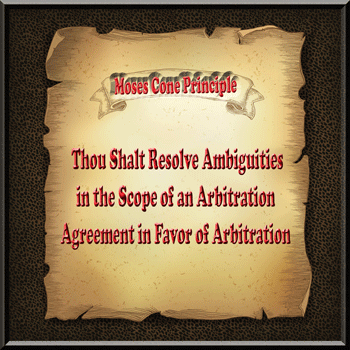
Issue No. 1 is simply whether the parties agreed  to submit to arbitration the SCA Parties’ claims against Armstrong relating to Armstrong’s alleged procurement of the consent award through perjury, fraud and other deceptive means. The key question is whether the SCA Parties’ disputes fell within the broad scope of the parties’ arbitration agreement. And the answer is driven in large part by the presumption in favor of arbitration, under which ambiguities about the scope of an arbitration agreement are resolved in favor of arbitration.

By comparison, recall that the answer to the question who decides arbitrability questions was driven by a presumption against arbitration: courts presume that arbitrability questions are for the court to decide unless the parties “clearly and unmistakably” agree to delegate those questions to the arbitrators. The whole point of agreeing to arbitrate is to have arbitrators decide disputes about the merits, and so when the question is whether the parties empowered the arbitrators to decide the merits of a party’s claim for relief, courts presume those questions are for the arbitrators to decide.

The presumption of arbitrability applies to case governed by the Federal Arbitration Act as well as cases falling under the Texas General Arbitration Act. It provides that ambiguities in the scope of an arbitration agreement are to be resolved in favor of arbitration. See, e.g., Moses H. Cone Mem. Hosp. v. Mercury Constr. Corp., 460 U.S. 1, 24-25 (1983); Mitsubishi Motors v. Soler Chrysler Plymouth, 473 U.S. 614, 626 (1985); G.T. Leach Builders, LLC v. Sapphire V.P. LP, No. 130497, at *21-22 & nn. 14 & 16 (Tex. Mar. 20, 2015); Branch Law Firm, L.L.P. v. Osborn, 447 S.W.3d 390, 394-98 & n.10 (Tex. App. 14 Dist. 2014). That means that if the scope provision of an arbitration agreement is susceptible to more than one interpretation, and at least one of those interpretations would require the dispute to be submitted to arbitration, then the court, as a matter of law, must find that the parties agreed to submit the dispute to arbitration. Continue Reading »

U.S. Supreme Court Grants Certiorari in Another Class Arbitration Case: Can the Federal Arbitration Act Spare DIRECTV an Extended Stay in Class-Arbitration-Waiver Purgatory?

March 31st, 2015 Appellate Practice, Arbitrability, Arbitration Agreements, Arbitration Practice and Procedure, California State Courts, Choice-of-Law Provisions, Class Action Arbitration, Class Action Waivers, Contract Interpretation, FAA Preemption of State Law, Practice and Procedure, State Courts, United States Supreme Court Comments Off on U.S. Supreme Court Grants Certiorari in Another Class Arbitration Case: Can the Federal Arbitration Act Spare DIRECTV an Extended Stay in Class-Arbitration-Waiver Purgatory?

On March 23, 2015 the U.S. Supreme Court granted certiorari in DIRECTV, Inc. v. Imburgia, No. 14-462. If decided on its merits, the case will be by our count the fifth U.S. Supreme Court decision concerning class arbitration decided on its merits during the period 2010 forward.

yay-1341284-digitalImburgia is a decision by the California Court of Appeals, Second District, Division One of which the California Supreme Court denied review. Like many other Federal Arbitration Act cases, it presents some interesting vertical conflict of law questions, but the California Court of Appeals does not appear to have resolved them in the way the U.S. Supreme Court presumably intended them to be resolved under the Volt and Mastrobuono lines of cases. 

The case centers  on a class-action waiver non-severability provision included in a consumer contract DIRECTV entered into in 2007, about four years before the U.S. Supreme Court ruled in Concepcion that the Federal Arbitration Act preempted California’s Discover Bank rule. The Discover Bank rule provides that class action waivers are unenforceable in litigation or arbitration proceedings. See, generally, AT&T Mobility LLC v. Concepcion, 131 S.Ct. 1740, 1753 (2011).

yay-3535433-digitalBefore Concepcion not only did the California state courts hold that the Federal Arbitration Act did not preempt the Discover Bank rule, but so did the U.S. Court of Appeals for the Ninth Circuit. Thus, at the time, the risk companies like DIRECTV and others with consumer class arbitration exposure had was that applicable state law would not only ban class arbitration waivers, but applicable federal law would permit that to happen.

So companies like DIRECTV and others built into their arbitration agreements a fail-safe mechanism under which the entire arbitration agreement would be rendered uneneforceable if state law rendered the class arbitration waiver unenforceable. In other words, the companies understandably viewed class action litigation to be a more favorable alternative than class arbitration if forced to choose between the two. Continue Reading »

SCA v. Armstrong: Anatomy of the Lance Armstrong Arbitration Award—Part III.B.1: Panel Issue No. 1: the Panel’s Authority to Decide the SCA Parties’ Sanctions Claims

March 29th, 2015 Arbitrability, Arbitration Agreements, Arbitration as a Matter of Consent, Arbitration Practice and Procedure, Attorney Fees and Sanctions, Authority of Arbitrators, Awards, Confirmation of Awards, Contract Interpretation, Grounds for Vacatur, Practice and Procedure, State Courts, United States Supreme Court Comments Off on SCA v. Armstrong: Anatomy of the Lance Armstrong Arbitration Award—Part III.B.1: Panel Issue No. 1: the Panel’s Authority to Decide the SCA Parties’ Sanctions Claims

Part III.B.1

Panel Issue No. 1: the Armstrong Panel’s Authority to Decide the SCA Parties’ Sanctions Claims

Introduction

Part III.A of our Lance Armstrong Arbitration Award series identified (a) the categories of issues (the “Issue Categories”) that a court can address on a motion to vacate an arbitration award on the ground the arbitrators exceeded their powers (the “Issue Categories”); and (a) the four specific issues that the Panel addressed in its award (the “Panel Issues”).

Panel Issue No. 1 was, as phrased by the arbitrators: “Does this Arbitration Tribunal have the jurisdiction or authority to decide and resolve the existing disputes between the named parties?” That issue falls into Issue Category No. 1: Issues concerning whether the parties delegated to the arbitrators—or were required to delegate to the arbitrators—the power to decide particular disputes.

summer-10343058Arbitrability

Whether or not the Panel had the authority to decide the SCA Parties’ claims against  Armstrong and Tailwind (the “Armstrong Parties”) depends on whether at least one 0f the parties requested the arbitrators to adjudicate those claims; and the other party either: (a) expressly or impliedly consented to the arbitrators deciding the dispute; or (b) objected to the request, but the claims were within the scope of the parties’ written pre- or post-dispute arbitration agreement.   Disputes what issues the parties submitted—or were required to be submit—to arbitration present questions of arbitrability. See, e.g., Howsam v. Dean Witter Reynolds, Inc., 537 U.S. 79, 83-86 (2002); First Options of Chicago, Inc. v. Kaplan, 543 U.S. 938, 942-45 (1995).

Relationship Between Arbitrability and the Post-Award Standard of Judicial Review

Ordinarily, questions of arbitrability are— in the allocation-of-decision-making-power scheme of things—for the court to decide, unless the parties have clearly and unmistakably agreed to delegate them to arbitrators. See, e.g., First Options, 543 U.S. at 944-45. Under a typical broadly-worded pre-dispute arbitration agreement, the vast majority of disputes that may arise between the parties—including disputes about arbitration procedure—are presumptively arbitrable, that is, they are subject to arbitration unless the parties clearly a nd unmistakably exclude them from arbitration. But when a dispute presents a question of arbitrability, then it is presumptively for the court to decide, that is, they are not subject to arbitration unless the parties clearly and unmistakably include them within the universe of disputes that must be submitted to arbitration.

yay-12776482

Where as here, an arbitrability issue arises at the award enforcement (or back-end) stage of the proceedings—rather than the pre-arbitration,  arbitration-agreement-enforcement (or front-end) stage (i.e., on a motion to compel arbitration or stay litigation)—then whether or not an issue is a question of arbitrability affects the standard of review. The standard of review is, in essence, the degree of deference to  which a court pays the arbitrators’ decisions on matters that are material to applications to confirm, vacate or modify arbitration awards. Continue Reading »